
LOCATION – Bunagee in Culdaff is in the townland of Carthage, in the Electoral Division of Culdaff, in the Civil Parish of Culdaff, in the Barony of Inishowen East, in the County of Donegal, in Ireland.
Location of the McSheffrey home on google maps – click here


Only an hour’s walk from the McSheffrey home and 15 minutes on a bicycle, you will find the stone circle at Bocan. 175 years ago they would all have had a healthy respect for the banshees, the faeries, and the stone circles. You can read many stories the children believed about the faeries in the school collection here: https://www.duchas.ie/en/cbes/4493804
BACKGROUND: In the 1800s, England and Ireland were ruled by successive monarchs: George IV, William IV, and Queen Victoria. In Donegal, daily life was vastly different from today—there was no electricity, as it wasn’t introduced to the area until the 1950s. Water had to be fetched by bucket from the well each day, and there were no toilets, either indoors or outdoors. In the early 1800s, children still attended “hedge schools,” informal outdoor schools for those denied formal education. Cooking was done over an open fire, making even the simplest meals a labor-intensive task.
I always had the idea that I would like to retire to a little house overlooking the ocean, and on the day I found my ancestors’ home, I understood why I love the sea even though I fear it. It takes only 10 minutes to walk from the McSheffrey home to the old pier of Bunagee and the McSheffreys were fishermen as well as small farmer tenants.
Finding My Great, Great Grandparents home in Donegal
One day during the summer of 2018 I found myself with my friend, Karen, in Donegal on an unplanned visit for weekend. One day while out driving, Karen proposed we have a go at finding what might remain of the McSheffrey homestead. It was a challenging task since I was unprepared. Various place names like Bunagee, Carthage, and Culdaff crossed my mind from the filed documents I had found over the years. Despite uncertainty, I hopefully consulted Griffith’s old valuation map and our current location on Google Maps, seeking inspiration to guide us in the right direction. On top of the McSheffrey list, I found the name Michael McSheffrey.
Just as we decided to give up and retrace our steps, the next bend in the road revealed a whitewashed cottage nestled in the landscape. A silver-haired man was busy with a lawnmower nearby on the side of the road. Seizing the moment, my friend rolled down the window, and asked, “By any chance, do you know if any McSheffreys used to live around here?”
To our utter delight and astonishment, the elderly man just happened to be Mr. Knox who not only acknowledged our inquiry but pointed directly to the whitewashed cottage. “Sure I do,” he exclaimed, “that house there belonged to George McSheffrey (Michael’s son).”

The narrative deepened as he himself had actually met George on one of his visits home to Donegal, and George had harbored a longing to return home. Sadly, George didn’t manage to return to live in Donegal. The McSheffrey house is now owned by Mr. Knox’s son, who built a newer house beside it. Interestingly, Mr. Knox’s ancestors were the presbyterian ministers who lived in Carthage House just down the road from the McSheffreys. I would like to know more about how they got along as neighbors. There are many questions I now wish I had asked Mr. Knox but I was unprepared for such a miracle. I notice the slates on the roof were rather new, even newer than the slates in the house next door. I wonder if the house lost it’s roof, as so many did, during the “night of the big wind” as it is known, on the night of 6th Jan 1839. https://en.wikipedia.org/wiki/Night_of_the_Big_Wind
On our way back to Letterkenny, we stopped at the post office in Culdaff, thinking if anyone would have more information for me, it would surely be the postmaster. He didn’t know anything about the McSheffreys but as we talked, his eye caught sight of a man passing the window. Quick as a flash, he came out from behind the counter and said over his shoulder as he headed for the door, “come on! if anyone knows anything about your ancestors, it’ll be that man!” And sure enough, when the passerby heard of my quest, he told me he remembered his own grandfather telling him that he had bought a fishing boat from George McSheffrey, before he and his family immigrated to the USA.

The STORY of MICHAEL McSheffrey & MARGERY McLoughlin
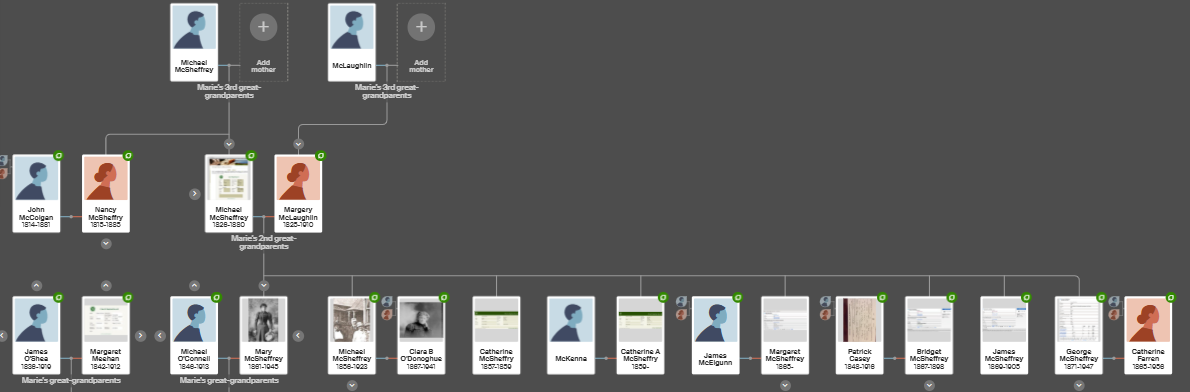
I begin my history of the McSheffrey Clan amidst the rolling hills of County Donegal in the far north of Ireland in the 19th century. The earliest member of the clan that I know about is Michael McSheffrey, who was born in 1823. To date, I have only discovered one sibling. His sister, Nancy McSheffrey, born in 1815, married John McColgan, and they had at least 7 children.
Michael’s wife, Margery McLaughlin, was born in 1925, but I have no more details about her family. Many of the McSheffrey neighbors were McLaughlin and so I am guessing Michael more or less married ‘the girl next door’
In the mid-1800s, Michael McSheffrey married Margery (Margaret) McLaughlin, marking the beginning of a family line that would shape my own existence. They were my great great grandparents. Griffith’s Valuation shows that Michael McSheffrey leased roughly 24 acres of land including a building, from the landlord, George Young. It is plot number 46 on Griffith’s map (below).
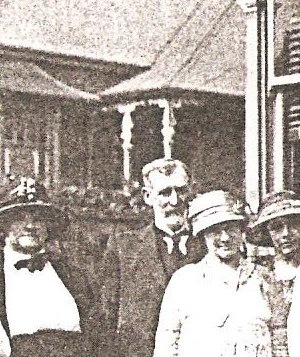
1856 Their first son, Michael, (photo below), was born in 1856, He married Clara Bridget O’Donoghue, and they had 10 children together in New Zealand, where he died in 1923. At least one of his family members, James, went to stay with him, and it is possible that initially that is where his sister, Catherine Anne, also went at some point.
1857 It looks like Michael and Margery had a daughter named Catherine McSheffrey in 1857. However, I am not 100% sure that this Catherine is theirs because her mother’s name is not on the birth certificate, and the sponsors were both McLaughlins, (but of course that could have been a Michael McLaughlin married to a Bridget McSheffrey).

1859 If Catherine was their daughter, then she died before 1859 because they baptised a second daughter named Catherine Anne, on April 12, 1859. Her sponsors were Barney O’Donnell and Mary Doherty

Catherine Anne appears to have married a man named James McKenna, and her last known whereabouts were somewhere in New Zealand. This fact is recorded in the processing of the estate of her brother, James McSheffrey, in 1905 and also recorded there is the fact that nobody knew her whereabouts in 1905. Family Mystery and QUESTION: What happened to Catherine Anne?
1861 was the year my great grandmother, Mary McSheffrey was born in Culdaff, Donegal. The sponsors at her baptism were James and Betty Morrin. The Morrins must have been close friends with the McSheffreys or the McLaughlins. Many years later, another son of Michael and Margery, named George, would go on to marry a girl named Catherine Farren who may have been the daughter of James and Betty Morrin Mary married Michael O’Connell, a member of the RIC stationed in Donegal and 15 years her senior, on July 31, 1881. They had two sons and one daughter, my grandmother. They moved from Donegal to Fermanagh to Cavan and finally settled in Milford, County Cork.

1865 The year 1865 marked the birth of Margaret McSheffrey in the picturesque Culdaff, where she would eventually marry James McElgunn, from Sligo and together they welcomed a son named James McElgun in 1892. However, there is another Family Mystery here, as there is no information as to what happened to Margaret and James. Their son, James McElgun, aged 10. was living with his grandmother Margery in 1901, and there is no record of his parents whereabouts. QUESTION: What happened to Margaret and James?
1867 Another daughter, Bridget, was born in 1867 and grew up to marry Patrick Casey. They moved to Belfast, County Antrim, and had four daughters and two sons. Bridget McSheffrey’s story has a sad and tragic ending.
1869 Two years later, in 1869, James McSheffrey joined the clan in Culdaff. He was a bit of a wanderer; we know he went to New Zealand and stayed with Michael for some time because he had an accident there and possibly also owned some land there. He died in New York in a drowning tragedy on September 4, 1905.
1871 witnessed the birth of George McSheffrey, who would go on to build a family of his own with Catherine Farren, sowing the seeds for a dozen more lives. George and Catherine moved to the United States with all their children; however, for at least three of their beautiful daughters, the future in America was bleak, to say the least. Indeed, onr might even wonder if it would have been best if the family had staying in Ireland.
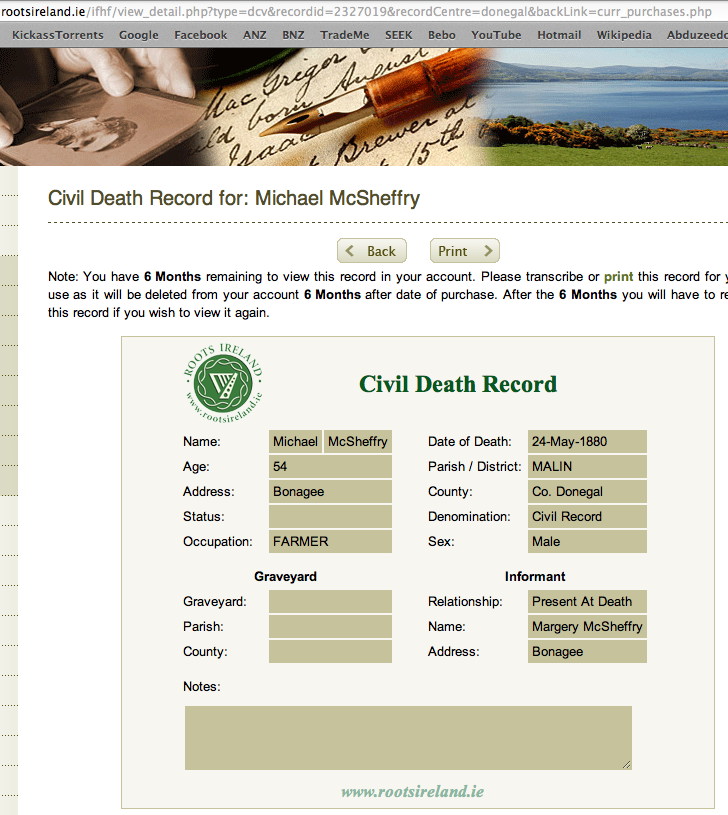
1880 Tragedy struck the McSheffrey household in 1880 when Michael, the stalwart patriarch, succumbed to lung disease at the early age of 54. Margery registered his death.

Donegal Industrial Fund
1883 A remarkable event happened around 1883 in Donegal, an event that was probably of benefit to the daughters of the McSheffrey family. Two remarkable people set up an initiative to teach the girls needlework and so enable them to earn a living for their families. I seem to have inherited the skills my great grandmother learned, and I have in my possession a white bedspread crocheted with fine cotton. It was made either by my grandmother for her “bottom drawer” in preparation for marriage or by my great-grandmother. Being skilled in needlework would also have benefited the grand-daughters later in life when they went to work as maids in the Big Houses in America. Here follows the story of that initiative.
Alice and Ernest Hart, moved by reports of hardship in Donegal, launched a remarkable initiative in 1883. Endowed with resources from Alice’s inheritance and Ernest’s medical career, they founded the Donegal Industrial Fund, kickstarting a network of lace schools across the county to revive traditional crafts like lace making, weaving, and embroidery. With initial funding and subsequent parliamentary grants, these schools flourished, supported by clergy and even receiving recognition from the National Board of Education. Their efforts expanded, with students exhibiting their work and gaining royal patronage, notably from Queen Victoria. Through strategic partnerships with London stores like Liberty and Debenhams and participation in World Trade Fairs, Donegal lace gained international acclaim. Despite the rise of machine-made goods post-World War I, the legacy of the Lace Schools endured, providing a skilled workforce for vocational schools and leaving an indelible mark on Donegal’s cultural heritage. Full story here: https://historyofdonegal.com/articles/
1901 In the 1901 Census, Margery is the head of the house, number 28 on the census records, in Carthage, County Donegal. The household consists of son George and his wife Catherine Farren and their children Michael, Maria Kate, James, George and John Joseph, and baby daughter Madge, her son James and her 10 year old nephew James McElgan (McElgunn) Where were young James McElgunn’s parents?

1910, at the venerable age of 85, Margery McLaughlin bid farewell to this world in Culdaff. Her daughter-in-law, Catherine, George’s wife, registered her passing. The collective tale of Michael McSheffrey, his wife Margery McLaughlin, and their descendants, to this date, still contains quite a few unanswered questions.
More Background
I copied the following extract from https://www.irelandxo.com/ireland-xo/history-and-genealogy/timeline/1846-famine-north-west-donegal the reason I copied it instead of just pasting the link is because sometimes links get broken or websites go offline.
The first bit which I copied to here is a brilliant description of life in Donegal in the time of Michael and Margery – before the famine hit.

The Years of the Famine in Fanad and North West of Donegal.
For many, many years previous to the setting in of 1846 and 1847, food was in the greatest abundance and easily obtained. The old people could mention an odd summer in their recollection in which the price of provisions did run high, the same being caused by hurricanes or the inclemency of a preceding harvest, but there was no such thing as starvation heard of at such times. Potatoes, the principal food of the people, grew everywhere and to perfection and on any soil into which a spade could be put; even the white sand in which there was apparently no substance threw up its crop to perfection, and in some places clay would be carried from deep soil to cover seed on the ledge of a rock, and by such contrivances a satisfactory yield would turn out.
The seasons turned out so good and the supply so great that man and beast had plenty to eat, and at the least amount of toil. The sea too seemed to be extravagant in its yield of fish, sometimes the shoals coming close to the dry land, and while one class of men took to labouring the land, another class living nearer the shore took to fishing as a better money-making business (and to make up for the shortness of crops owing to the scarcity of land); there were always two or three in the fishing family who raised as much in crops as possible and who would provide firing, so that a reserve of food and fuel was sure to be laid up for the winter season.
The means of obtaining shelter and gaining a livelihood were so easy that the people, as I have said in speaking of villages, became in a short time very numerous, and everyone who was entitled thereto claimed certain rights, that is their share of what should belong to them; from this arose divisions and subdivisions of land—land then being very valuable—and this went on until tenements were cut up into the smallest patches, and each family was subsisting on whatever means they provided for themselves, very few being in any debt. It has been some times argued that the Irish could not subsist on what Ireland would or could produce. But between 1840 and 1845 when the population was the largest, they lived within themselves on their own produce, and yet there were thousands of acres which could but never were cultivated at distances not very far off.
There was very little imported, and the exports were in proportion—I mean this of the country districts. There may have been luxuries and trade in cities far removed from where we are describing, but there was no Indian meal known then, flour was seldom used, and as for tea or sugar, if such things came under a roof once or twice a year, it was enough. To show how little such luxuries were thought of, there was a shopkeeper in the place, the same being reckoned wealthy; at or before November, when laying in his stock, he brought home a chest of tea, and if he had all sold before that day twelve months, he considered himself at no loss. It is true tobacco, soap, salt, iron and leather could not be done without, but each of these commodities was used as sparingly as possible. Every beardless brat of a boy did not have a pipe in his pocket or his jaw at this time, and if the old man got an ounce of tobacco he always measured it by his finger to see if the ounce was a good or a bad one, and he knew how to use it: a certain allowance was for the day, and when the pipe was “going” the old woman could take a “pull” if she fancied, but she never thought of buying on her own account. Very often the old man was his own messenger as he had less to do and spent the forenoon going certain distances looking out for his ounce of tobacco; being disappointed in too many places, he rattled about from one petty shop to another. The family at home did not mourn much for his absences, as his temper was ruffled in the morning, but if he returned unsuccessful so much the worse.
The people lived on home produce: potatoes, milk, butter and plenty of fish, the latter always with the poorer class. Eggs were consumed at home, and a few who could afford it laid out their accounts to have a fat bullock killed at a certain time. The first man in the neighbourhood who took up the idea of buying and collecting eggs was mocked at, and it was hidden that they were given to him in barter by the women. He went round the neighbours with a large basket on his arm, stealing himself towards the dwellings, being ashamed and partly afraid of being seen by the men; from the nature of his employment, he could not escape a nick-name which stuck to him, Micky Goo-ga, Mickey of the egg. When he had collected a sufficient quantity to make up a load for a large, lazy but very quiet donkey, he tackled a pair of “side creels” to the animal and slowly made his way to the town, a distance of over 14 miles.
A mail boat now-a-days could not be better watched than were his departures and arrivals then. He did not proclaim his hour of departure, but to go unknown he could not, and he had to oblige the women by bringing home various things. His memory was severely taxed in trying to recollect every person and every thing. To assist himself he would tie up the money and the sample together, and when in town on spreading out the records, he easily knew what he wanted. The people at home soon taught him what articles were needed to open a shop with, and by degrees he was able to supply certain things himself: needles, pins, thimbles, smoothing irons, in short a hardware store on a small scale. Many had no land, no property beyond the cabin they lived in, and their chief dependence lay on the ocean, that is the seaweed thrown up by it: they used it for manuring the land and they turned it into kelp (which will be better explained further on). Such people got land to crop here and there from those who had it to spare, and they paid for it in money, in goods or in labour. Nor was it enough. In addition to the residents occupying the already over-crowded houses, huts, and hovels, every one stuffed with inhabitants, there was regularly each year an influx of supplemental population, who arrived about the time the crops were nearly gathered in, that is November; they were induced hither from former experience of the friendly hospitality and plentiness of potatoes and fresh fish. Fresh herrings were so plentiful some winters that the salt which could be got was too scarce for curing them, and a friend or a stranger got as many at the shore as he had means of carrying and the man who brought a bag of salt could please himself in his bargain.
The newcomers or yearly visitants consisted of tinkers, pedlars, pipers, fiddlers, show-men and beggars, and many otherwise idle with no profession. The tinkers carried at that time the idea of their being an honourable people; they arrived in crowds or caravans, women and children and their beasts of burden, the donkeys, forming the advanced guard, and these arrived perhaps a day before the men. Each head of a tinker family owned a donkey or two, and he was reckoned a poor man unless he had one of the best class of animals of that species. This animal was very useful to them, for when properly equipped, strapped and harnessed as a tinker knew how to, on it were placed the children, the youngest of the family, two or three on each side, as also the bedclothes and other baggage (such as the bellows and other articles), and the animals were driven by youths capable of doing so, and they were surrounded by the women. The men kept at a respectable distance from the advance party and formed another procession with long stout sticks over their shoulders; with these they supported boxes made half of leather and half of wood called “budgets” on their backs; marching leisurely they knew from experience where to billet, and for this place they headed. When encamping in a village or villages, they tried to keep as close to each other as possible, but every tribe, half tribe or family [of tinkers] knew where to set up, and without asking liberty they took possession of some man’s fireside and then and there laid aside their traps; a foraging party was told to provide provender for the donkeys, and clean straw for “shake downs”—that is heaps of straw for themselves to sleep upon. Any one in the surrounding neighbourhood having straw or hay shared it with the tinkers, whether willing or unwilling, in fact they almost dared not refuse. These visitants were likened to welcome friends or guests who had been absent for some time; to refresh themselves, they spent a day or two lounging in straw, rehearsing stories about their travels, their adventures and encounters, and the many performances with the blackthorn they had participated in at fairs and markets. When fully rested, the male portion of the tinkers went to work, that is to mend old umbrellas or broken pots, but as for pans or kettles, they were as rare as a Jubilee coin; there was no talk about them, as the consumption of tea and of the “cake on the pan” was only in infancy years after.
To make up for kettles and pans were tins of all descriptions and sizes, tin pandies, tin plates, tin lanterns, the latter being thought a great and useful invention, as it served a person to carry a lighted candle from the dwelling to the stable. All these things were made by the men; the women sold them for cash or bartered them for goods, the wife starting each morning along with another member of the family, and instructions were given to a third to meet them at a certain time and place with the beast of burden, the donkey, to carry home the provisions and other things collected by them. In this way they put up the winter half year without rent and without taxes. Beggars became so saucy that they refused things offered except those of the best quality, and if their burden became too heavy they would empty their bag into a corn field or other hiding place and leave the contents to rot, and proceed anew. As for the fixed inhabitants, a few weeks labour in spring and summer served to raise as much food as was sufficient for them and some to spare, and as for winter work, with most of them there was none. That part of the year was gone through in attending soirees, dances, balls, wakes, markets, the public house and the shebeen house. In every second or third village there was a butcher who kept buying and killing sheep, and getting the same mostly by card-playing: he got the money down and more than the price, and if one of these sheep-killers managed at November to make up the price of one to start with, his trade was opened and it was as useful to him as a bank; moreover he often had his own stake in, and he was not, to be sure, the worst of players. So he was kept going for the season; no sooner was one sold than another was bought, and very often the animal was played for and the money received while it was yet in the hill with the wool on its back and the purchase to be made. … “
I haven’t found the grave/s of Michael or Mary McSheffrey in Donegal.