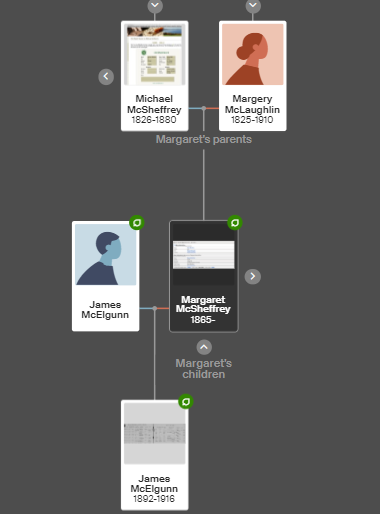
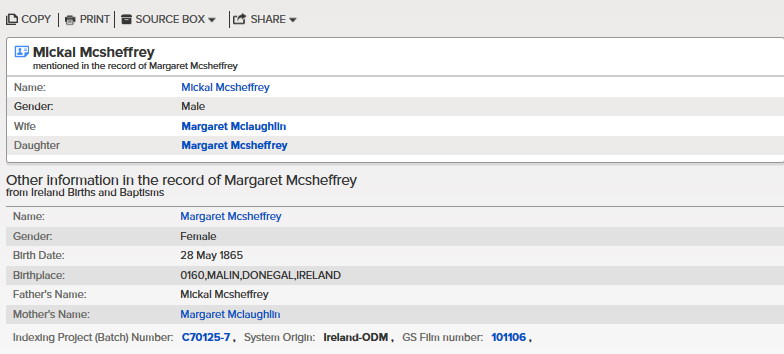
Margaret McSheffrey was born in Malin, Donegal, on May 28, 1865. Her parents were Michael McSheffrey and Margery McLaughlin. She was baptized in Bunagee Parish, Culdaff, Co. Donegal. The sponsors were Michael McColgan and Elizabeth O’Donnell. I think Michael McColgan might be Margaret’s uncle, the son of Michael McSheffrey’s elder sister, Nancy.
Margaret married James McElgun. Their son, also named James (jr.), was born in 1892. I can find no information or even death records for the parents, Margaret or James, while young James was living with his grandmother when the 1901 census was taken.
James McElgunn (McElgan)
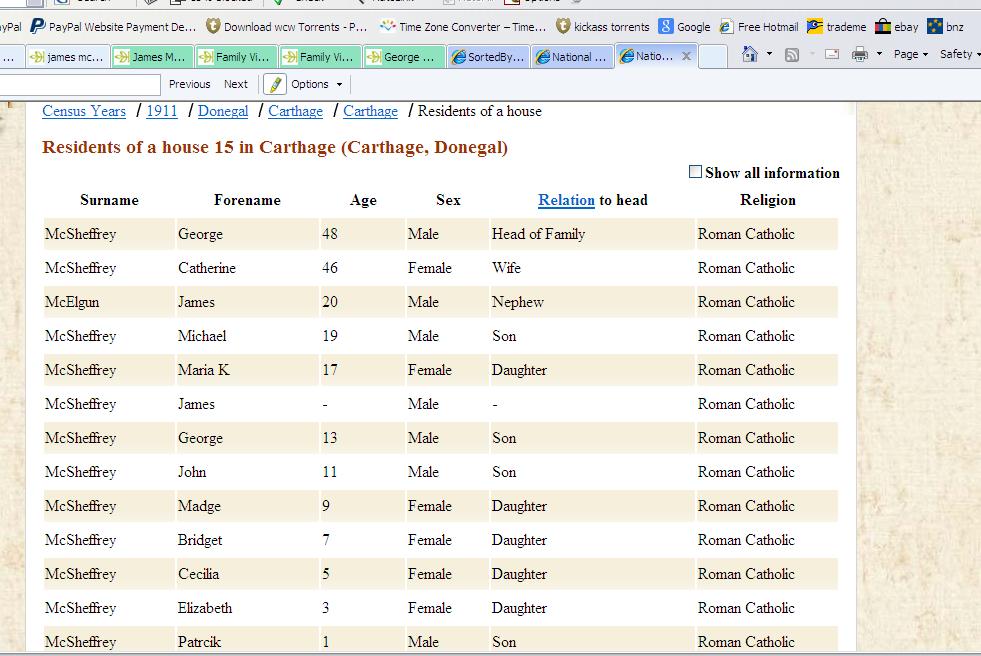
James McElgunn (jr.) was born on Sept. 27, 1892. In the 1901 Irish Census, he was staying with his grandmother in Donegal. When Margery died, James’ uncle, George, was listed in the 1911 census as head of household; James was then 20 and still living there.

QUESTION: What happened his father and mother? There is no information or trace of either mother nor father.
On February 13, 1915, James McElgun (jr.) sailed with his cousins Michael, James, and George McSheffrey aboard the SS St Paul from Liverpool to New York. He went to stay with another cousin called George McSheffrey, 109 Heath St., Roxbury, Boston, Massachusetts, in New York.
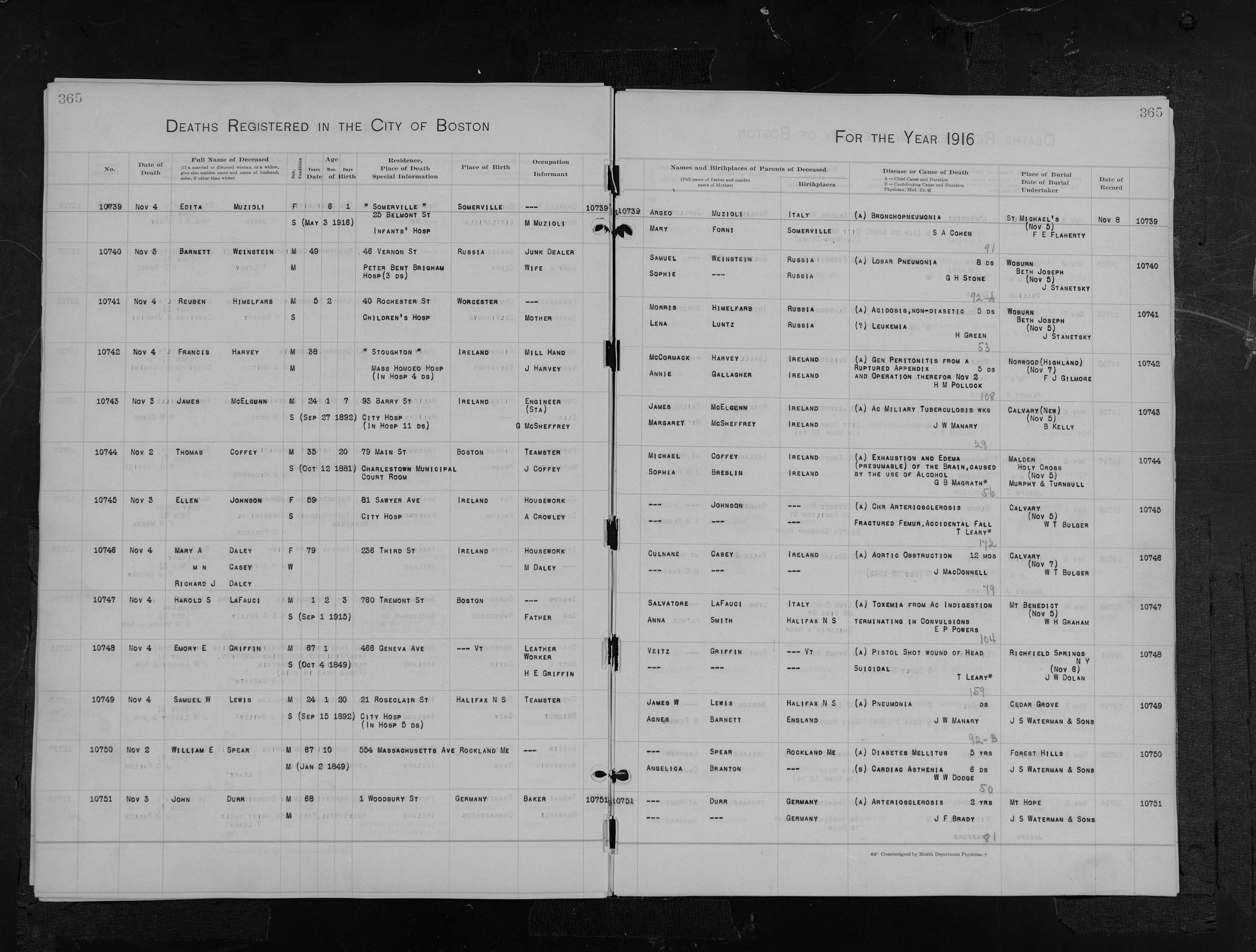
James (jr) died on November 3, 1916, in the City Hospital in Boston. He was 24 years old and died of military tuberculosis. At the time, his address was 93 Barry St. He was an engineer, and his death was recorded by G McSheffrey – who had emigrated with him from Ireland in 1905. His body was removed for burial from the residence of his cousin, George McSheffrey Buried at Calvary Cemetery (new), Mattapan, Suffolk County, Massachusetts, USA.
Military tuberculosis, also known as “soldier’s disease,” was a significant health concern during World War I and various other conflicts. Tuberculosis (TB) is a bacterial infection that primarily affects the lungs but can also affect other parts of the body. In the context of the military, crowded and often unsanitary conditions in barracks and trenches provided fertile ground for the spread of tuberculosis.
Tuberculosis was a global health issue during that era, and soldiers, due to their close quarters and physical strain, were particularly vulnerable to the disease. Many soldiers who were already infected with TB before entering the military would experience a reactivation of the disease due to the stress and poor living conditions.
The story is based on the following document