

John Collins was born in 1893 in Cappanihane, County Limerick, to Mary Collins and her late husband, also named John Collins. His birth came under the shadow of sorrow—his father had passed away only months earlier in a horse-training accident at their home in Ballinruane, near Kilmeedy in County Limerick
After the tragedy, Mary returned with her children to her own family home in Cappanihane. At the time of John’s birth, she was 38 years old and already the mother of five—two sons and three daughters.
A family story has been passed down over the years, hinting at a quiet drama: that John may have held a special affection for a young woman named Mary Horgan—an affection that caused ripples in the family’s plans. It’s said that Mary had been intended for another—possibly one of John’s brothers—but instead left for America with John. As the story goes, Mary Collins, in front of her daughter Mary Ann, took the family’s savings from the Charleville bank and gave it to John to help him begin a new life across the Atlantic.
What became of him, for a long time, remained unknown. He never returned to Ireland, and his family heard nothing more after his departure. It was decades later, through the curiosity of a woman named Angie White—seeking out her Irish roots—that the threads began to reconnect. Angie found both John in New York and his nephew, my father, James, in Ireland. She visited my father and passed along John’s address. James wrote to his uncle, but no reply ever came. The letter was later found among John’s belongings after his passing.
One day, long after the events had faded into family memory, my aunt Margaret (Peg) Collins discovered an engagement ring buried in the garden of the old farmhouse. Quietly, it was presumed to be the ring once meant for Mary Horgan—returned, for reasons now lost forever.
Like many Irish family tales, the truth behind this one remains unclear. John had two brothers—Denis and Patrick. Denis was married and had a child in 1929, four years before John’s marriage in America. Patrick, while unmarried, was 18 years older than Mary Horgan, casting some doubt on whether he was truly the one she had once been promised to. Perhaps the story has been polished or reshaped over time.
What we know for certain is that on November 12, 1933, in Manhattan, John Collins married Mary Katherine Horgan.


John Collins a the age of 27, arrived in Quebec, Canada on the 15th June 1920, aboard the SS Caroline from Liverpool, with the stated intention on his immigration form that he intended to stay in Canada for “improvement” – in other words “to better hims. He had bought his ticket from a Birmingham shipping agent. John had $600 – $600 in 1920 was equal at the time to Sterling Pounds 120 – a sizeable amount.


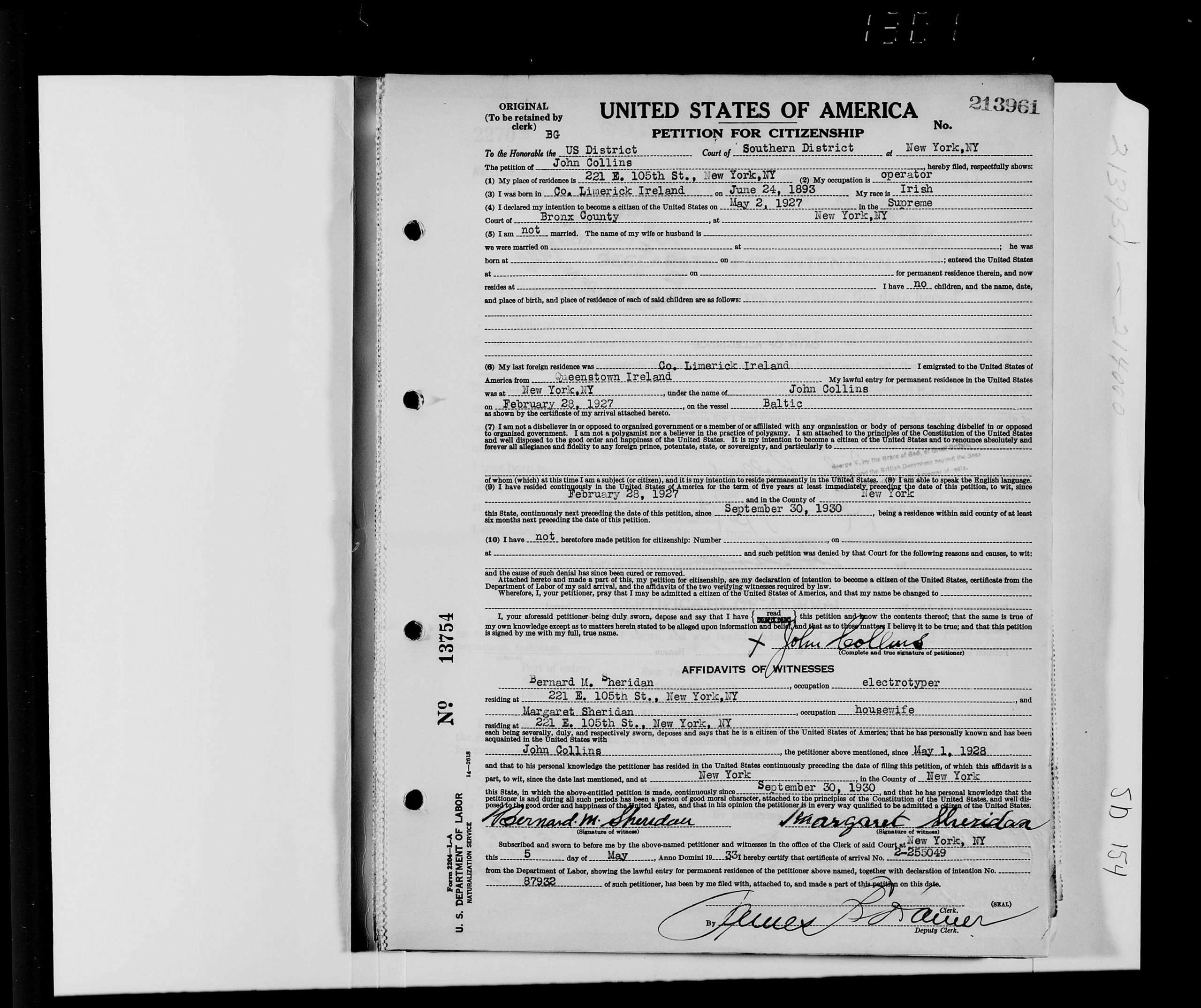
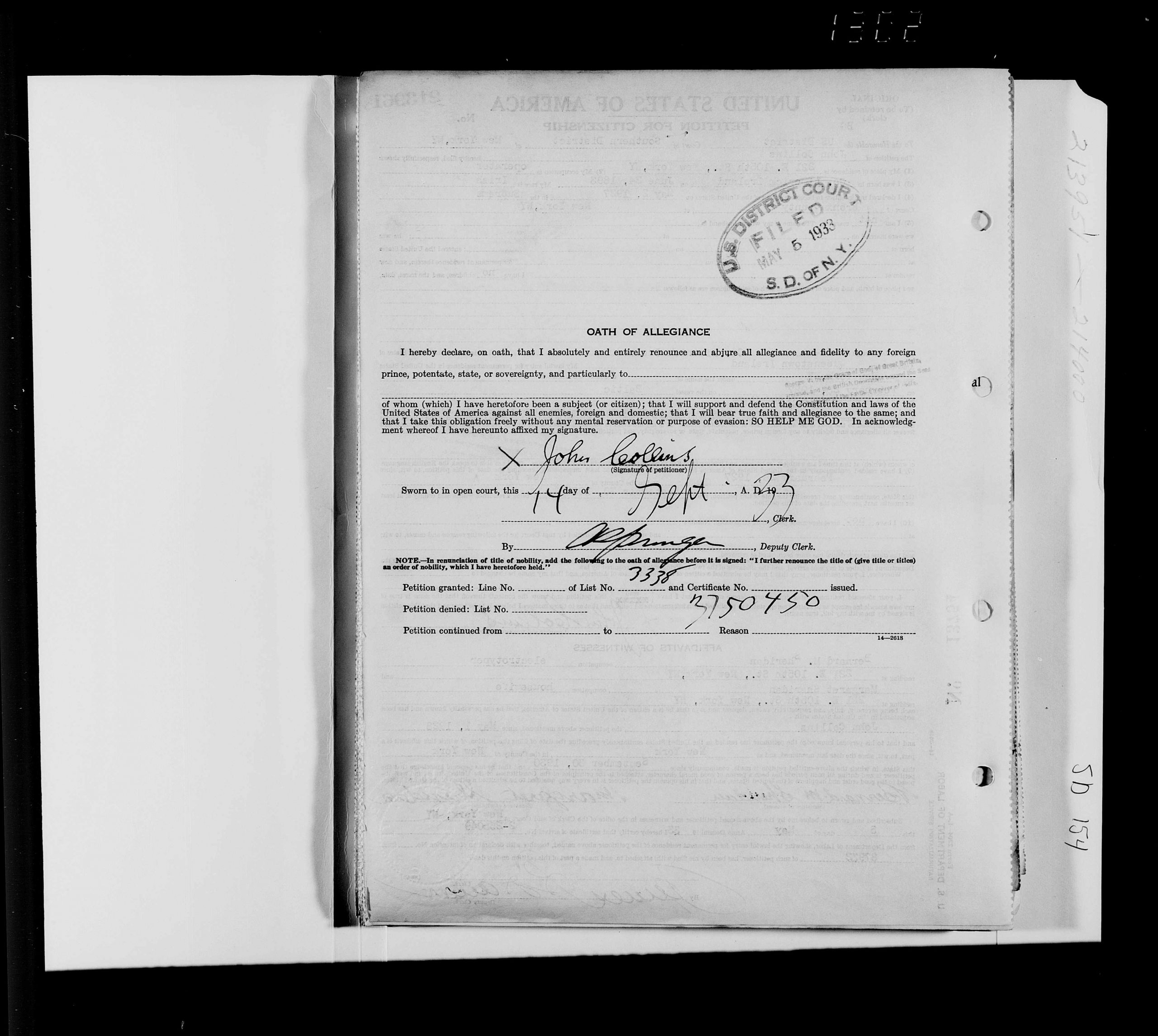
The following are John’s documents for naturalization: He applied on 2 May 1927 for citizenship. He states he arrived in New York from Queenstown (Cobh), Ireland, aboard the ship “Baltic” on February 28 1927 He was staying at 221 East 106th St., New York. And the witnesses who attested to his statements lived just a few doors away.
The 1911 Irish census shows the Horgan family from Ballylongford, Adare, Co. Limerick


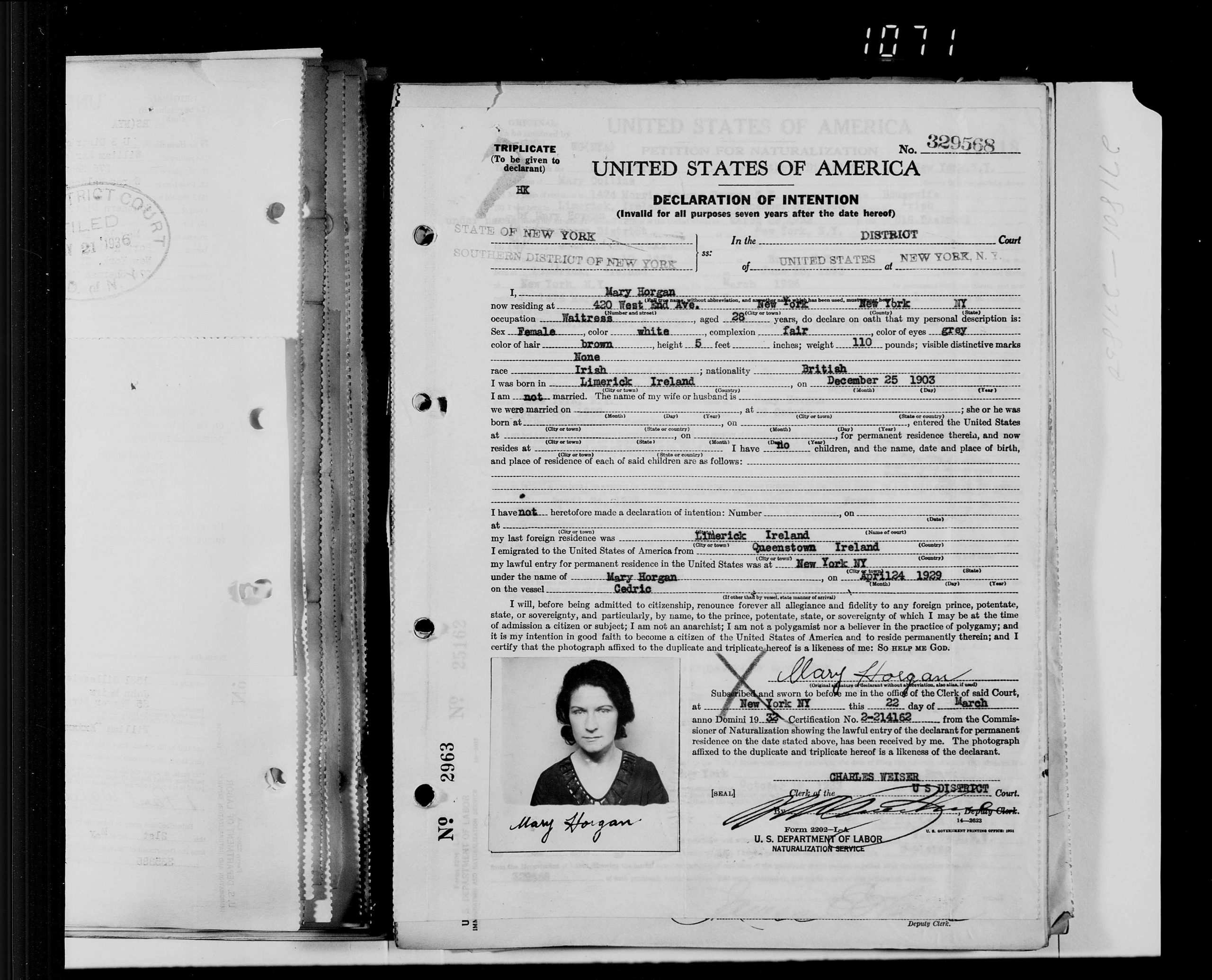
Hereunder are the naturalization documents for Mary Kate and they throw a doubt on the story about the elopement for the following reasons:
- Mary Kate immigrated to the USA on the ship “Cedric” on 24 April 1929
- She most likely stayed with her brother, Alphonsus Horgan and worked as a waitress.
- John swears in the document that he has known her in the USA only since 1 May, 1931


This is the letter Jim Collins (my dad) wrote to his Uncle John in 1971. 


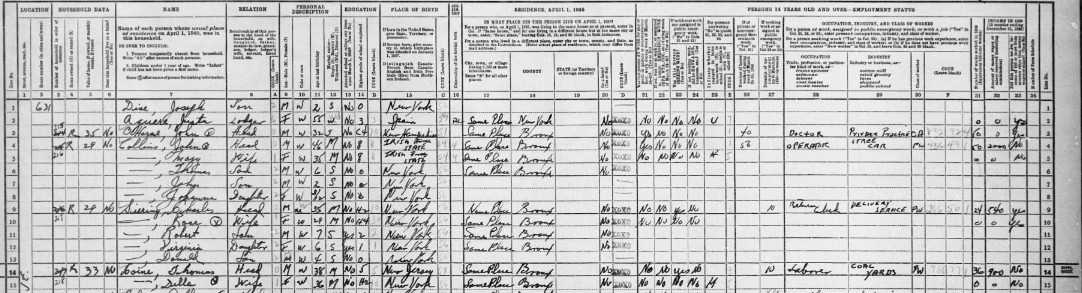
The Collins Family: A Decade in the Bronx, 1940–1950
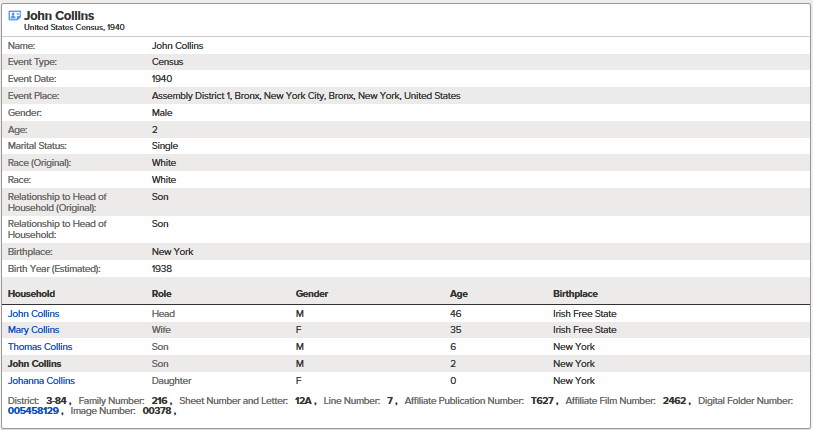
In 1940, John and Mary Collins were already well into building their American dream. Living at 138th Street, Bronx, New York, they were raising four young children: Thomas (5), John Jr. (2), and Joanne (3 months old). Both John and Mary had naturalized as U.S. citizens. John worked full-time as a street car operator.
Mary, like many women of the time, was a full-time homemaker. Her role was vital—not only in raising their children but in anchoring the family amid the turbulence of the era. In 1940, the United States was cautiously watching the war in Europe. While life continued in the Bronx, rationing, uncertainty, and increasing nationalism would shape the coming decade.
A New Home – 1950 Census
By 1950, the Collins family had moved to 727 Guiney St—still in the Bronx but a different apartment building.
According to the key details in the 1950 census:
-
John Collins (Head, 58) – Still working full-time as a Bus Driver. While we don’t have a listed income in this census, his continued employment into his late 50s suggests strong work ethic and possibly limited access to retirement options, as pensions were still evolving post-WWII.
-
Mary Collins (Wife, 47) – Still managing the household. With at least six children at home, her role remained central to family life.
Children by 1950:
- Thomas (15) – Born on 6 Sept 1934. In 1950 he was attending school; likely preparing to graduate high school.

- John Jr. (12) – Also attending school. John was born in 1938.
- Johanne (10) – Attending school. Johanne was born in 1939.

- Michael (9) – Born on 2 Sept 1940.

- Anthony (8) was born in 1944
- Francis (5)
- Patrick (2)

Life in the Bronx (1940–1950)
The Bronx in the 1940s and 1950s was a dynamic place, full of immigrant families like the Collins’. After the hardships of the Great Depression, many residents—including Irish Americans—found stable employment in manufacturing, like John’s role at the paper box factory. Public schooling improved, and healthcare access expanded, especially with the New Deal reforms still rippling through society.
The end of World War II brought economic renewal. Returning soldiers settled down, families grew rapidly, and communities became more stable. For the Collins family, this meant more children, a bigger apartment, and a sense of permanence.
The 1950s also saw the beginning of migration out of city centers into the suburbs. Although the Collins family remained in the Bronx during this census, their children would come of age during the years when families began moving out of New York City in search of space and homeownership in newly built suburbs—a trend encouraged by government-backed loans and new highways.

For reasons of their own, John and Mary never spoke of their Irish roots to their children. It was only after John’s death, when one of his granddaughters was going through his belongings, that my father’s letter came to light—and with it, a quiet thread back to the Collins family in Ireland.
John Collins died in New York in 1982 and is buried in St. Raymond’s Cemetery beside his wife, Mary, who pre-deceased him in 1958,
