
Timothy O’Shea was born in 1796. I do not know his parents’ names, but he had two brothers – Thomas and James.
1849 in the Valuation Records – the House Books for Kilmacanerla North we find James O’Shea and Timothy O’Shea. So we can see that both James and Timothy had their own houses on the land.
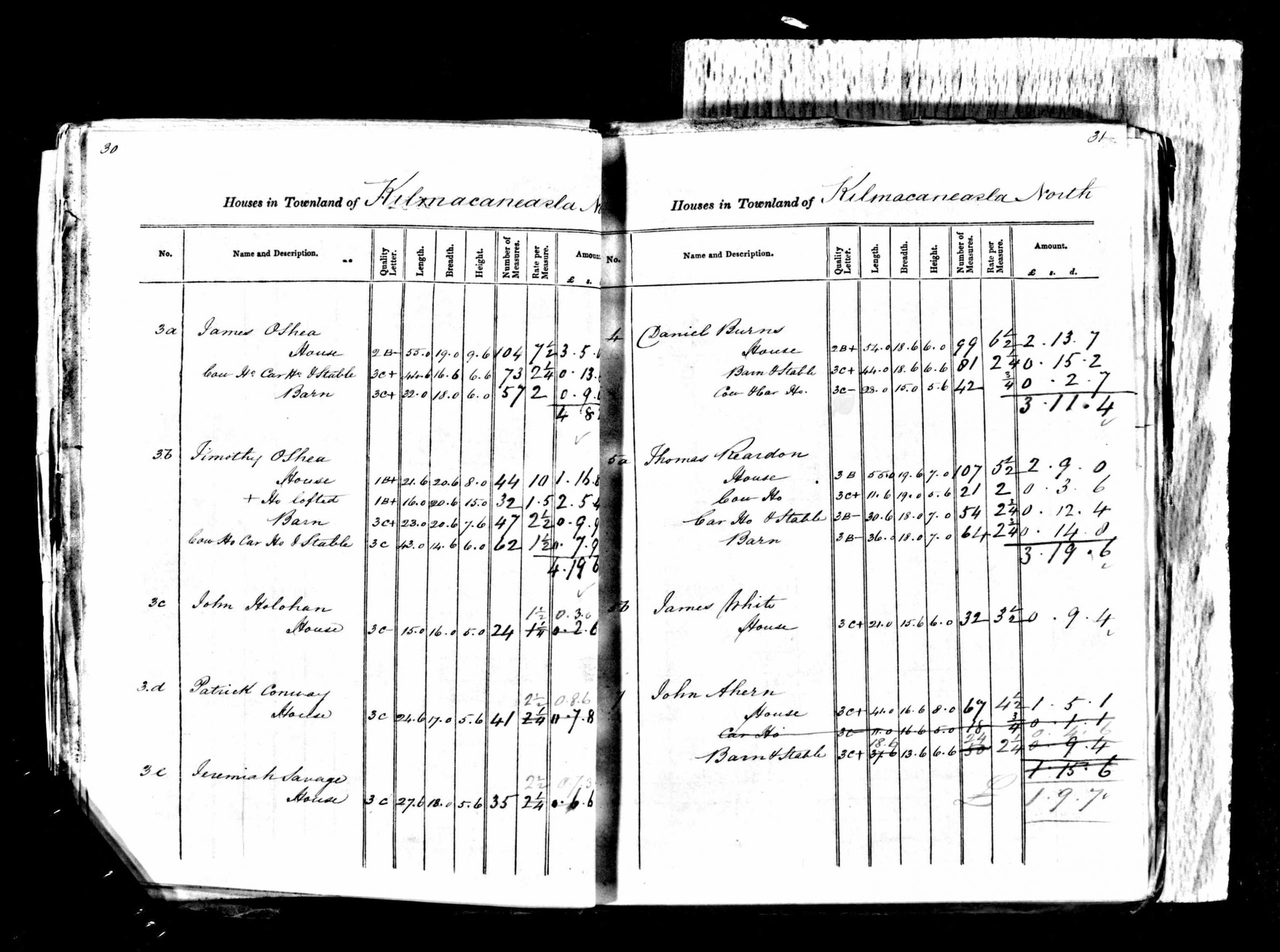
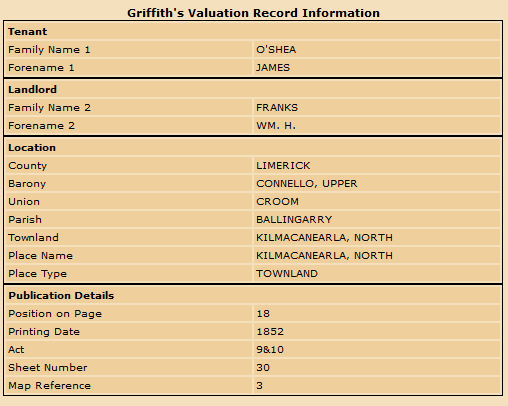
In 1852, according to Griffith’s Valuations, James and Timothy were tenants on 107 acres in Kilmacanerla, leased from Wm. H. Franks. This parcel included two instances of “house, out offices, and land.” Notably,
- James sublet a house and small garden to Edmond Kerr, as well as
- a house to Patrick Conway. Concurrently,
- Timothy sublet a house to a John Shea on the same property. (Griffith Valuation Map) and the Valuation Book listing
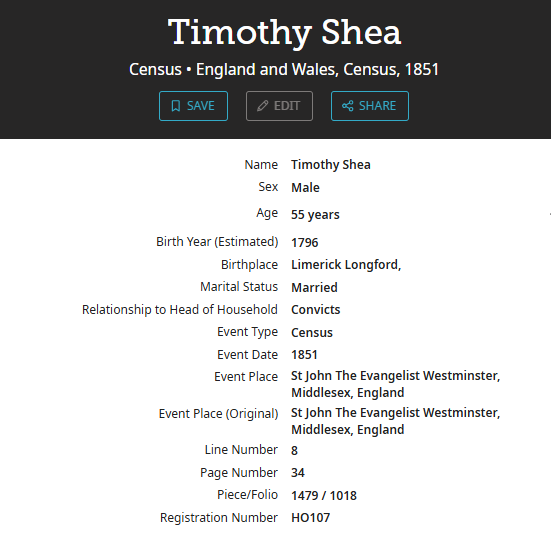
The years of the Great Famine in Ireland were 1845 – 1852 and it would appear that Timothy at least had a problem paying the rent and went to England where he got arrested for forgery in 1851.
Timothy O’Shea’s Desperate and Foolhardy Attempt to Pay the Landord’s Rent
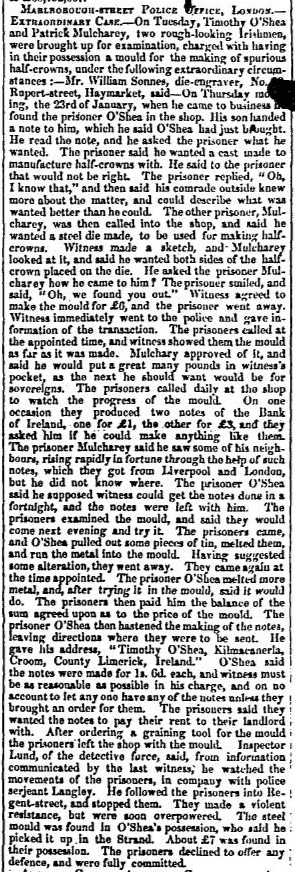
The following is from The Belfast-Newsletter of Friday, February 21, 1851 – Page-4. The clipping is difficult to read so I have re-written it here:
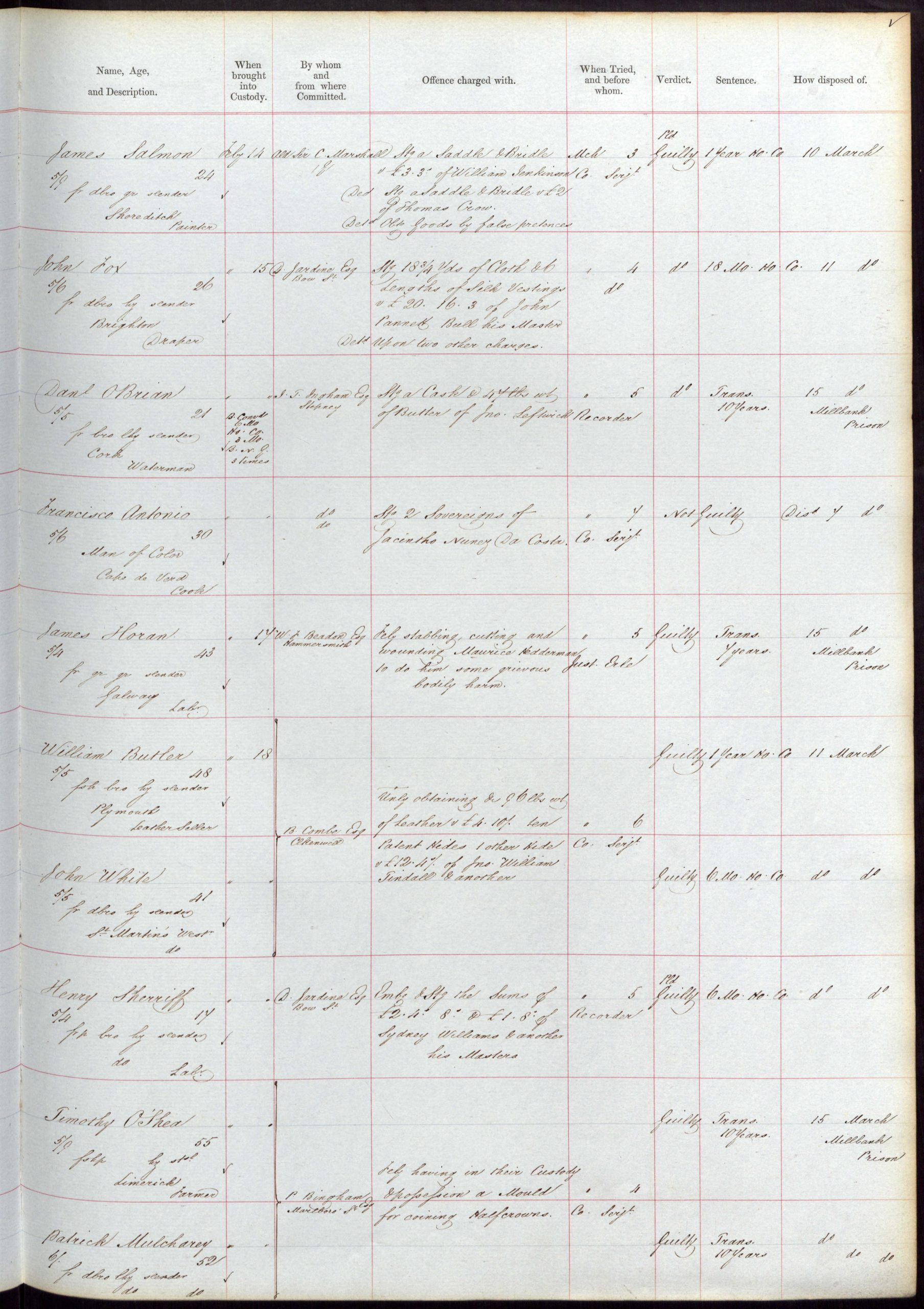
“MARLBOROUGH-STREET POLICE OFFICE, LONDON. EXTRAORDINARY CASE.—On Tuesday, Timothy O’Shea and Patrick Mulcahey, two rough-looking Irishmen, were brought up for examination, charged with having in their possession a mould for the making of spurious half-crowns, under the following extraordinary circumstances:—
Mr. William Sonnes, de—grave, & Co., Regent-street, Haymarket, said—On Thursday morning, the 23rd of January, when he came to business he found the prisoner O’Shea in the shop. He handed him a note to him, which he said O’Shea had just bought. He read the note, and he asked the prisoner what he wanted. The prisoner said he wanted a cast made to manufacture half-crowns with. He said to the prisoner that would not be right. The prisoner replied, “Oh, I know that,” and then said his comrade outside knew more about the matter, and could describe what was wanted better than he could.
The other prisoner, Mulcahy, was then called into the shop, and he said he wanted a steel die made, to be used for making half-crowns. Witness made a sketch, and Mulcahey immediately said that it was the thing he wanted. Witness made a sketch, and Mulcahy looked at it, and said he wanted both sides of the half-crown placed on the die.
He asked the prisoner, Mulcahy how he came to him. The prisoner smiled and said “Oh, we can found you out.”
Witness agreed to make the mould for £6 and the prisoner went away. Witness immediately went to the police and gave information of the transaction.
The prisoners called at the appointed time and the witness showed them the mould as far as it was made. Mulcahy approved of it, and said he would put a great many pounds in witness’s pocket, as the next he should want would be for sovereigns.
The prisoners called daily at the shop to watch the progress of the mould. On one occasion they produced two notes of the Bank of Ireland, one for £2, the other for £3, and they asked him if he could make anything like them.
The prisoner Mulcahey said he saw some of his neighbours raising rapidly in fortune through the help of such notes, which they got from Liverpool and London, but he did not know where. The prisoner O’Shea said he supposed witness could get the notes done in a fortnight, and the notes were left with him.
The prisoners examined the mould, and said they would come next evening and try it. The prisoners came, and O’Shea pulled out some pieces of tin, melted them, and run the metal into the mould. Having suggested some alteration, they went away.
They came again at the time appointed. The prisoner O’Shea took out some lead, and after trying it in the mould, said it would do. The prisoner then paid him the balance of the price agreed upon as to the price of the mould and it was arranged that the prisoners should call the next night.
The prisoner O’Shea then hastened the making of the notes, leaving directions where they were to be sent. He gave his address, “Timothy O’Shea, Kilmacanerla, Croom, County Limerick, Ireland.”
O’Shea said the notes were made for one shilling and 6 pence each and witness must be as reasonable as possible in his charge and on no account was he to let anyone have any of the notes unless they brought an order for them.
The prisoners said they wanted the notes to pay their rent to their landlord with.
After ordering a graining tool for the mould the prisoners left the shop with the mould.
Inspector Lund of the detective force said from information communicated from the last witness he watched the movements of the prisoners with police sergeant Langley. He followed the prisoners into Regent St. and stopped them. They made a violent resistance but were soon overpowered. The steel mould was found in O’Shea’s possession, who said he picked it up in the Strand. About £7 was found in their possession.
The prisoners declined to offer any defence, and were fully committed.”
- 1851: on March 3, both Timothy and Mulcahy were sentenced to 10 years transportation
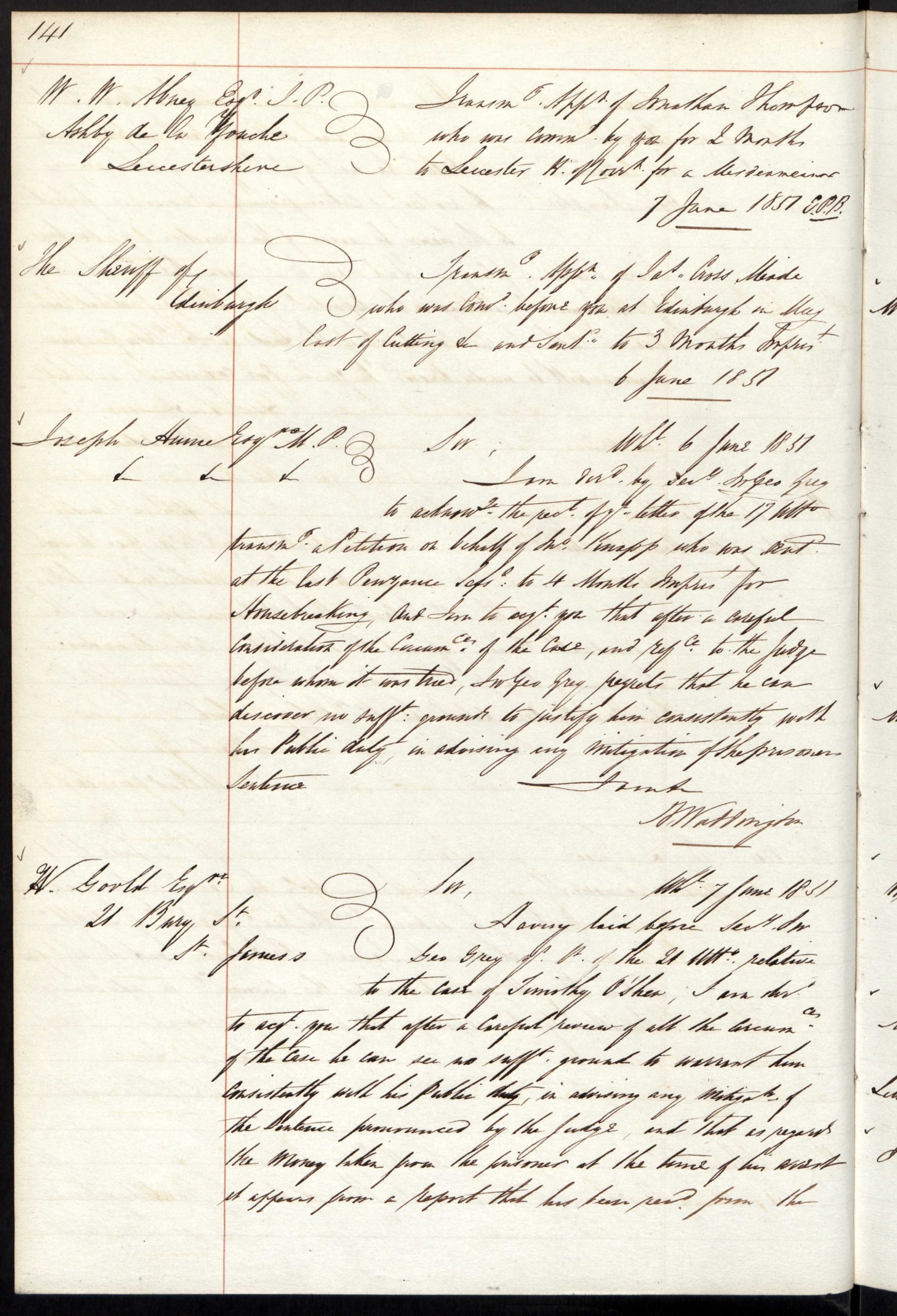
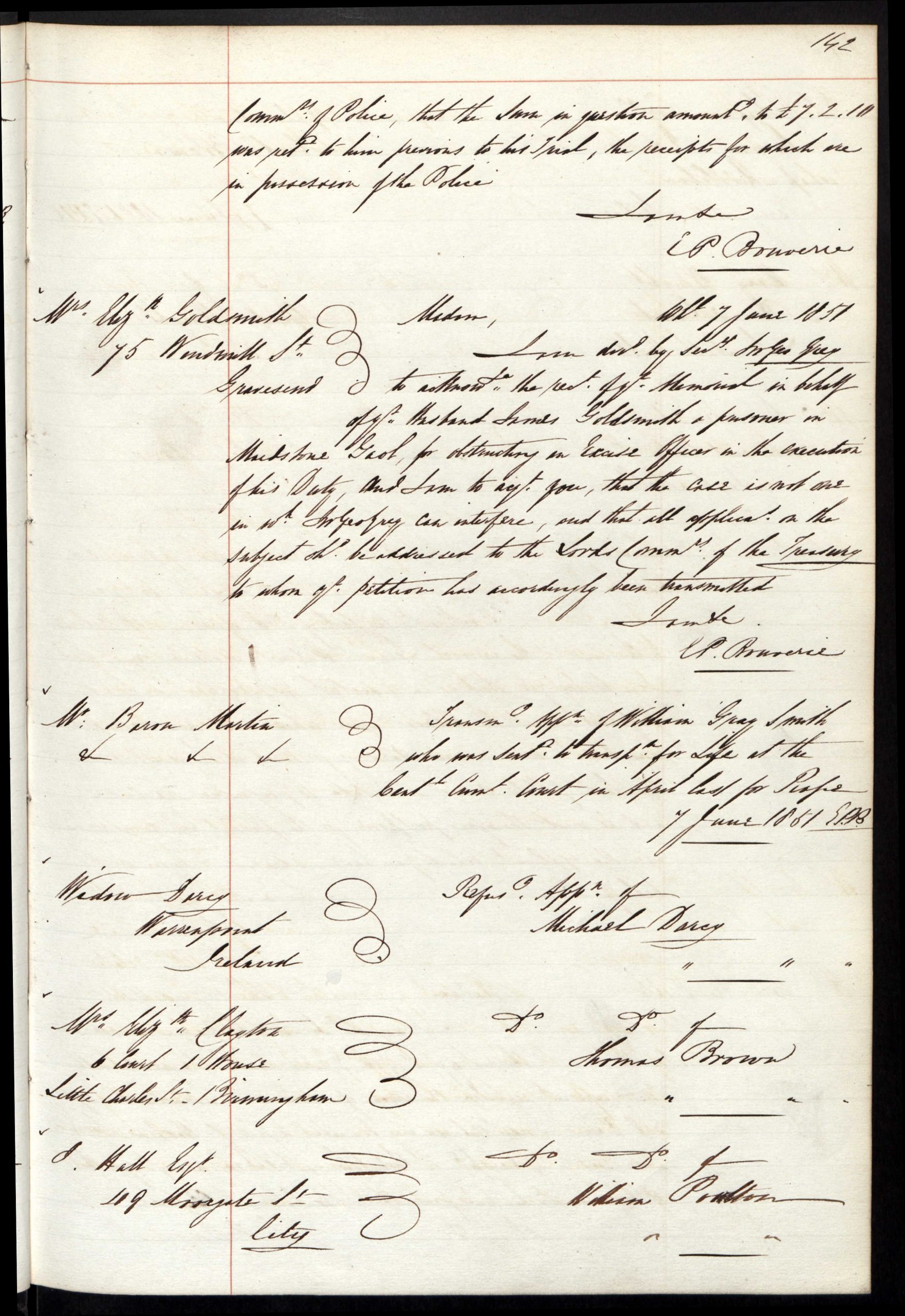
1851 Petition for mitigation of sentence denied:
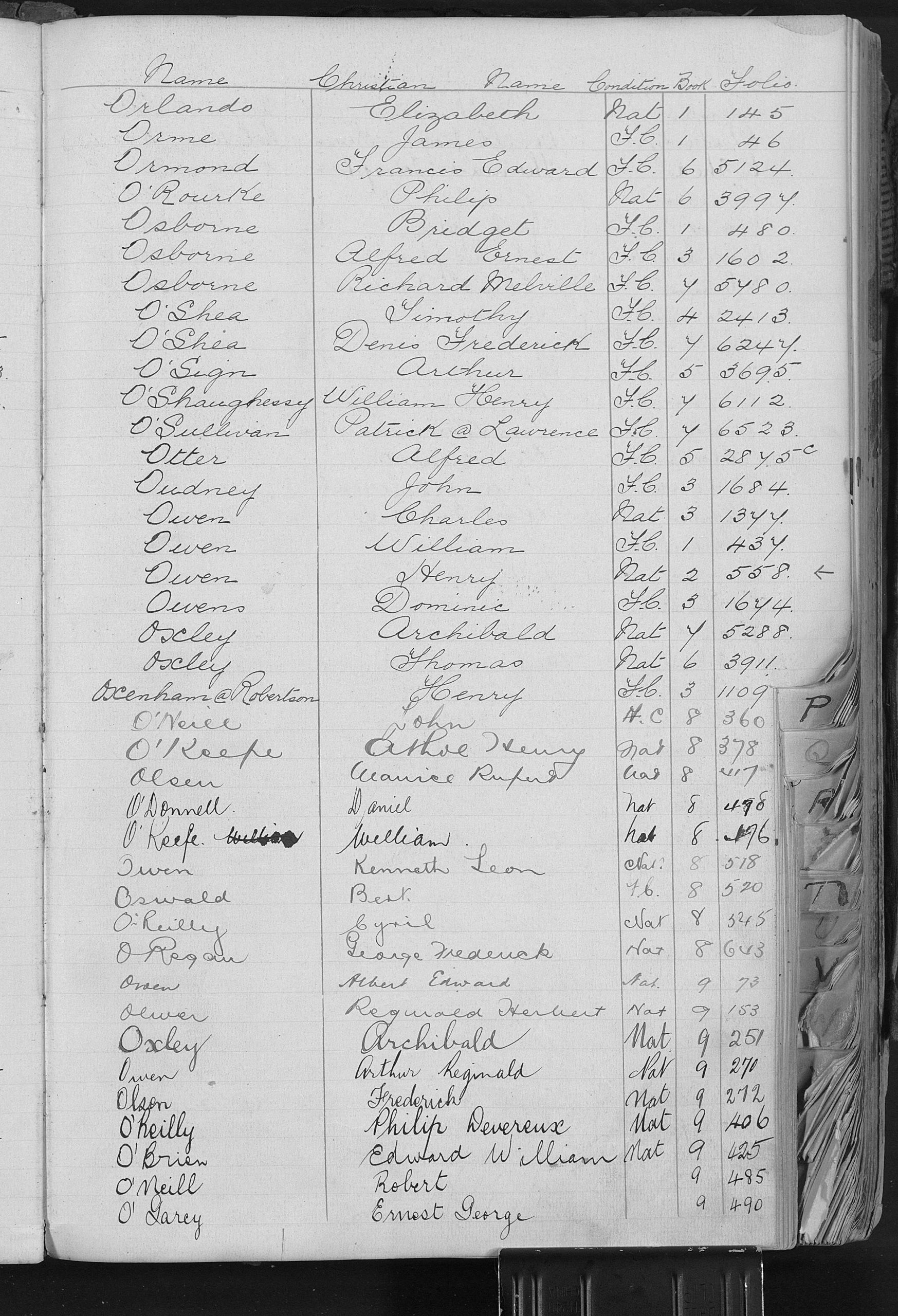
I don’t know if the following Timothy in the Tasmanian Prison Records, is our Timothy O’Shea but it is the only record I have found so far that might relate to him.
Millbank Prison in 1851: A Labyrinth of Reform and Suffering
In 1851, Millbank Prison stood on the banks of the Thames as both a monument to penal reform and a grim testament to its failures. Opened in 1816 as Britain’s national penitentiary, it was meant to embody a new, enlightened approach to punishment: solitary confinement, silence, and moral reflection. But by the middle of the 19th century, the reality inside Millbank had become far darker than the ideals it was built upon.
Designed as a hexagonal maze of corridors and cells, Millbank was confusing and disorienting by design—intended to break prisoners down for repentance. In practice, it often led to mental deterioration. Prisoners in 1851 were subjected to long periods of isolation in cramped, damp cells. The air was heavy with the smell of mildew and human misery, and the silence—imposed as part of their supposed rehabilitation—often drove inmates to the brink of madness.
Disease was rampant. The prison had suffered several serious outbreaks of illness, including typhus and dysentery. Poor ventilation, inadequate sanitation, and a diet of bread, gruel, and water left inmates weak and vulnerable. Though medical care existed, it was rudimentary at best, and many prisoners left Millbank in worse health than they entered—if they left at all.
1851 was also the year of the Great Exhibition, when Victorian Britain proudly displayed its industrial and cultural achievements to the world. But behind the gleaming façades of progress, places like Millbank revealed the darker underbelly of the empire. Thousands passed through its gates on their way to penal colonies in Australia, often after enduring months of psychological torment.
Millbank was a prison built on high hopes and crushed by reality. By 1851, it had become a place of suffering rather than salvation—a quiet, hulking reminder that reform, without humanity, can still look very much like punishment.
Did Timothy serve his sentence in Tasmania and, if so, what became of him after that?