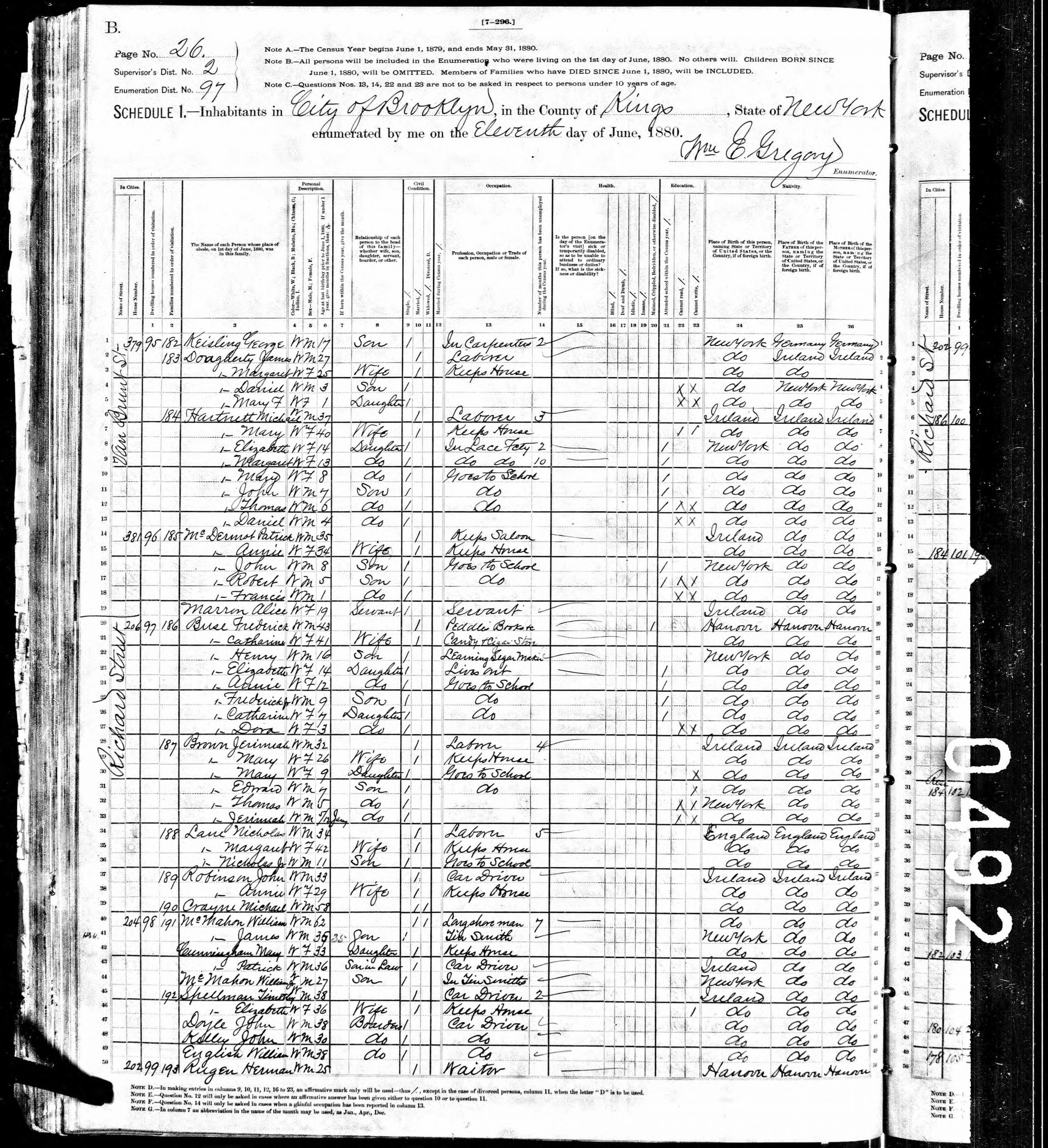
1880 US census as 1848, would have made him 32 at that time.
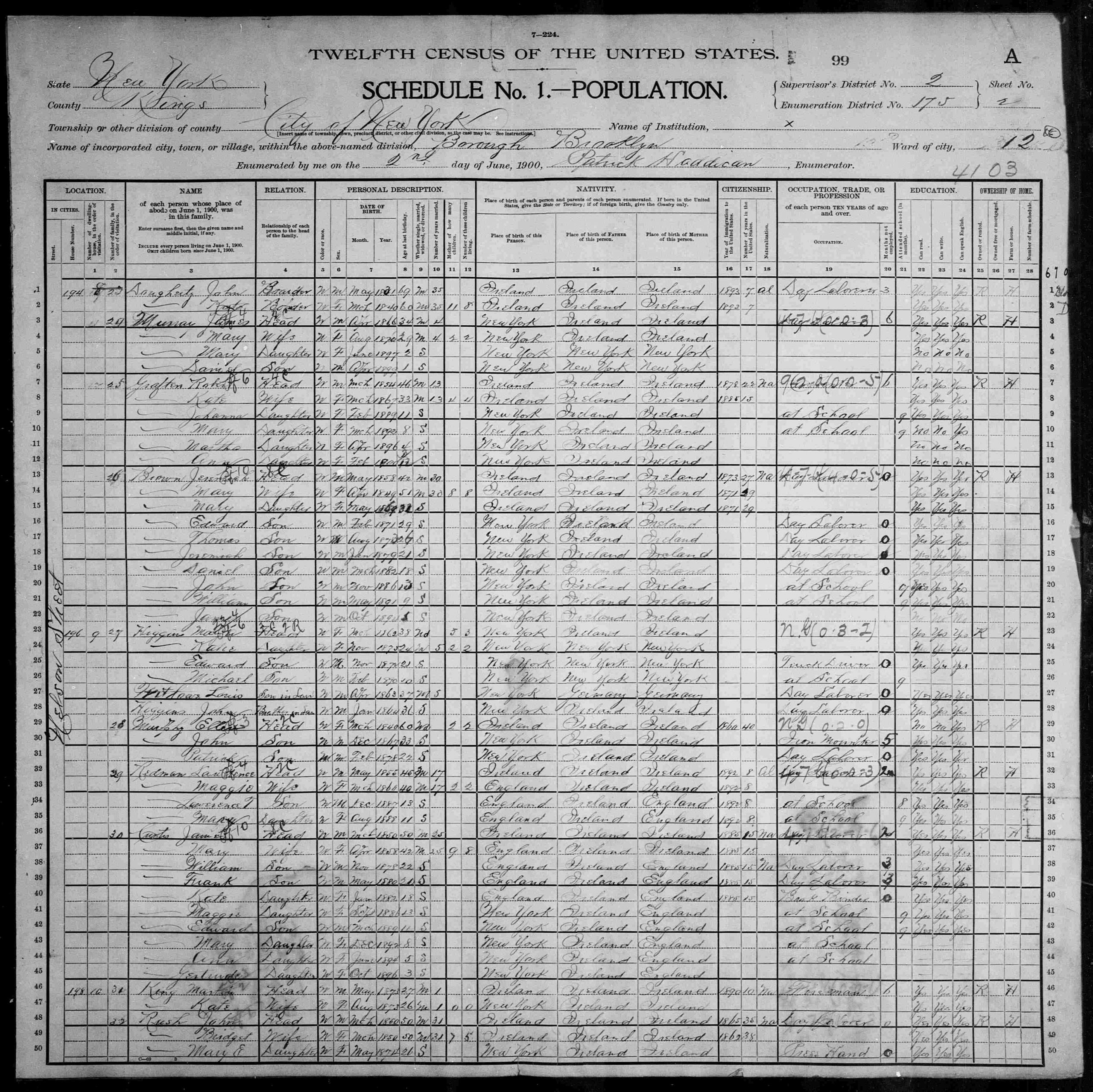
1900 census, it is May 1858, indicating he was 42. This cannot be right because that means he would have been 12 when he married Mary O’Connell
1900 census notes that Jeremiah and Mary were married in 1870,
they had been married for 30 years by 1900, and
immigrated in 1873.
I believe Jeremiah’s correct birth year was 1848, not 1859.
In 1870, Mary, then 21 years old, married Jeremiah Brown, who was 22. Three years later, in 1873, they set sail for New York. I can find no record of them either together or separately on the Ellis Island records.
By 1880, Jeremiah and Mary Brown had settled at 206 Richard Street in Brooklyn, Kings County, New York. Life was not without its struggles—Jeremiah, then 32, was seeking work as a laborer but had been unemployed for four months. Meanwhile, Mary, aged 26, managed the household as a full-time housekeeper within their own home.
Their growing family now included four children. Their eldest, Mary, was 9, followed by Edward, 7, and Thomas, 5. The youngest, Jeremiah Jr., was just five months old—a new life in a household navigating the uncertainty of employment in a rapidly growing city.
Brooklyn in the late 19th century was a hub for Irish immigrants, many of whom had fled famine and hardship in Ireland only to face new challenges in America. The streets of Kings County were lined with tenement housing, where large families often lived in cramped, rented rooms. The Irish were a dominant presence in the city’s working-class neighborhoods, taking jobs in construction, dock work, and domestic service—anywhere labor was needed. Employment was precarious, and for men like Jeremiah, months of joblessness could mean the difference between stability and destitution.
Despite the hardships, the Brown family was part of a tight-knit Irish community. Churches, social halls, and neighborhood taverns served as gathering places, where news from the old country was exchanged, and support was found among fellow immigrants. While Mary kept the household running, Jeremiah, like many Irish laborers, likely relied on word-of-mouth to find work—waiting each morning at hiring points or checking with former employers for opportunities. In a city constantly under construction, hope remained that work would return.
1880 June census
By 1900, the Brown family had relocated to 195 Nelson Street in Brooklyn, where they rented their home. Now 41, Jeremiah had become a naturalized citizen—a significant milestone for an Irish immigrant in an era when securing citizenship could mean better employment opportunities and greater social standing. Unlike in previous years, he had found steady work as a day laborer, a testament to both perseverance and the gradual economic shifts in Brooklyn as industrialization created more jobs.
Mary, now 51, continued to anchor the household, managing the daily responsibilities of home life and caring for the younger children. The couple’s family had grown considerably over the decades, with eight of their children still living at home. Their eldest, Mary, was now 31, followed by Edward (29), Thomas (26), Jeremiah (21), Daniel (18), John (13), William (9), and James (6). The older sons—Edward, Thomas, Jeremiah, and Daniel—had all followed in their father’s footsteps, working as day laborers. Like many working-class Irish families, the Browns likely relied on their sons’ wages to help sustain the household.
At the turn of the century, Brooklyn was a city in transition. The construction boom brought by the completion of the Brooklyn Bridge in 1883 had opened new opportunities, but work was still grueling and unpredictable. Day laborers, often hired for street paving, factory work, and dockyard tasks, faced long hours and hazardous conditions. Yet, for the Browns, the ability to find stable work—particularly for multiple family members—suggested they had carved out a foothold in their adopted city.
Life in an Irish immigrant household was often a balancing act between preserving old traditions and embracing American life. The family’s naturalization and workforce participation marked their steady assimilation, yet the Irish-American identity remained strong, reinforced by community churches, social clubs, and local businesses.
Their daughter, Mary: I can find no birth record either in Ireland or the USA
In the 1900 census, a compelling anomaly surfaced. Mary, their daughter, is documented with a birth year of 1869, indicating she was 31 years old at the time. What’s intriguing is the apparent alteration in the census record: it seems the original entry for Mary’s details was erased and replaced with new information. Yet, what makes this alteration even more curious is the revelation that her parents had been married for only 30 years. This meticulous recording by the census enumerator suggests the possibility that Mary was born before her parents’ marriage—a detail that prompts speculation as to whether Jeremiah Brown was her biological father. Moreover, considering the societal norms of the time, it raises questions about the circumstances surrounding Mary’s birth and her parents’ marriage. Was it a love match, or was it arranged? These questions, though speculative, add layers of intrigue to the family’s history.
1900 June census
Their son, John – tragedy
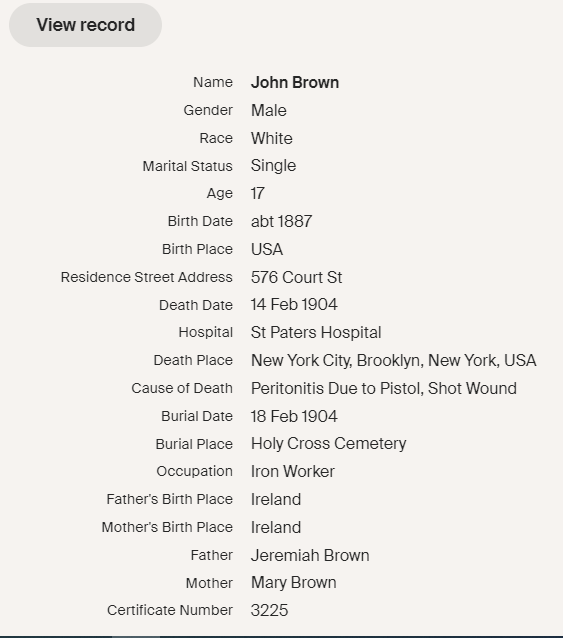
In the heart of Brooklyn, tragedy struck their son, John, on February 14, 1904. Aged somewhere between 17 and 20, he passed away at St. Peter’s Hospital due to peritonitis from a gunshot wound inflicted by a pistol.
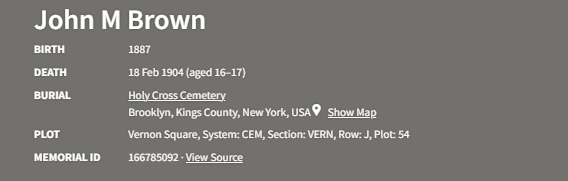
John lived at 576 Court St. and worked as an ironworker, likely alongside his brothers at the Dry Dock. His final resting place is Holy Cross Cemetery in Brooklyn, where he was buried on February 18. He rests in Vernon Square, System: CEM, Section: VERN, Row: J, Plot: 54.
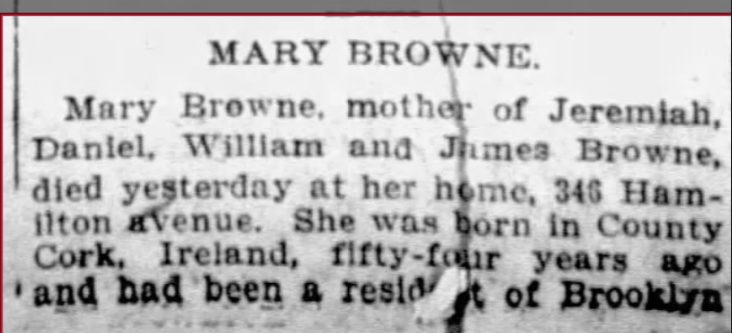
In 1910, the absence of Jeremiah, who had passed away, left Mary, aged 60, a widow. She resided in what seemed to be an apartment located at 346 Hamilton Avenue, Brooklyn, NY. Joining her were her sons: Edward, aged 37, employed as an ironworker at the Dry Docks; Jeremiah, aged 30, also an ironworker at the Dry Docks; Daniel, aged 28, likewise employed as an ironworker at the Dry Docks; William, aged 19, engaged as an ironworker at the Dry Docks; and James, aged 17, working as a coppersmith at the Dry Docks.
What were the Dry Docks? The Brooklyn Navy Yard is a shipyard and industrial complex located in northwest Brooklyn, New York City, New York. The Navy Yard is located on the East River in Wallabout Bay, a semicircular bend of the river across from Corlears Hook in Manhattan. It is bounded by Navy Street to the west, Flushing Avenue to the south, Kent Avenue to the east, and the East River to the north. The site, which covers 225.15 acres, is listed on the National Register of Historic Places. Wikipedia
This seems to be our Mary O’Connell Brown – however, it’s from 1914 and says Mary died 54 years previously – but that means she would have been born in 1860 NOT 1849
Postcards:
I have some christmas cards sent by members of the Brown family to Ireland:
To Miss Mary O’Connell (Mary Frances O’Connell 1889 – 1984) from Daniel Brown, 346 Hamilton Ave., Brooklyn, NY. It says “Dear Cousin, hoping you are in good health. I sent some cards to you, did you get them? From your cousin.
To Mr. Michael O’Connell (1846 – 1913) from Dan Brown. It says “My Dear Uncle, I send you this pretty postcard which I hope will please you. This card is as nice as I could send. All is well, from your nephew.
To Miss Mary O’Connell (Mary Frances O’Connell 1889 – 1984) from Dan Brown. It says “My dear cousin Mary, I hope you like this postcard which I am sending. We received your letter and photos which we were very happy to get. Why you are a big girl by your picture. We can only make out you and your father and D. Fitzpatrick. Let me know where your mother stands and James. From your cousin
To Mrs Michael O’Connell (Mary McSheffrey O’Connell 1861 – 1945) from Dan Brown. It says “My dear aunt, I send this postcard hoping you will be pleased with it. Mother got Mary’s picture and she was very glad for it. We can only pick uncle and Mary out of it. And …. is that you standing near rear of house? Your nephew.
To Mr. James O’Connell (1882 – 1938) from It says “Dear cousin, I send this nice postcard to you. It is a long time since I wrote to you. I am reading about the great murder trial that happen in Charleville. My mother told me she knew that Scanlon when he was a lad. My father had a fight with his father coming from a fair one year. My mother sends her love to you and all boys. Wishing you a merry Christmas and a happy new year. From Dan (presumed sent in 1909)
Below is the story of the murder of Bridget Scanlon that Dan refers to in the postcard above – therefore, the above postcard must have been sent in 1909. I have copied and pasted the full story here because it has been my experienc that posting links is not enough. Information disappears off the internet every day and I would like to ensure the pieces written by others that I refer to on this website will not disappear.
People drive carts outside Meadowvale Dairy Company in Charleville, c 1910. Photograph: National Library of Ireland/Flickr commons
“Annie fed the donkey while she waited for her younger sister. Bridget had left her at the north end of main street, outside Lynch’s shop, to walk back into town to buy a brush; an add-on errand at the end of their trip to Charleville for new boots.
Ten minutes passed. Annie became anxious. She decided it was time they began the journey back to Feenagh, over the border in Co Limerick. Bridget, about a fortnight shy of her 19th birthday, had said she would go to Galway’s shop for the brush. That’s where Annie started.
The story the elder sister was told at Galway’s was the same one she heard minutes later at the hardware and then the drapery; Bridget had not been in. At about 4pm on July 12th, 1909, Annie left, hoping her sister had gone ahead with neighbours. Arriving home 3 hours later, she discovered this not to be the case.
The girls’ mother, Kate, set out for Charleville herself that evening, according to a report in The Irish Times, leaving Annie in the house. She had three other sisters besides Bridget, and two brothers. William Scanlan, husband to another sister, Ellen, returned at about 9pm that evening, having spent the day at the opening day of the Cahirmee horse fair.
Faced with the news, William didn’t seem too worried, offering: “She must be gone to America or some place.” That evening, the police were alerted.
‘Covered with grass’
Eight days after Bridget’s disappearance, in a field on the road to Charleville station, two men discovered a woman’s body in a ditch.
“It was found by accident in the field by the roadside,” reads another report in The Irish Times, “covered with grass . . . and partly decomposed.” The branches of a poplar tree, plucked from over a nearby fence, further obscured the remains.
John Donoghue, one of the two men who found the body, said he became “weak at the spectacle, and reported what he had discovered to the police.”
A sergeant named Purcell was the first police officer on the scene: “The position of the clothes suggested that the body had been dragged some distance face downwards. From what he knew, [the sergeant] came to the conclusion that this was the body of the missing girl, Bridget Gayer. “
A postmortem revealed five revolver “punctures”, all fired into Bridget’s back, though only some of the pellets remained; “three bullets were found in all in the body, and a bullet that pierced the apex of the heart caused instant death.”
Sgt Purcell immediately set out for Feenagh – he already had a suspect. Questioning during the week had already revealed that William Scanlan’s account of his own movements on the day of Bridget’s disappearance did not add up.
Scanlan, about 40 years old at the time of his arrest following the discovery of Bridget’s body, had gone to Charleville on the morning of the 13th to conduct his own door-to-door searches, repeating “again and again” his theory that she must have gone to the United States, perhaps “with some young fellow who was able to keep her.”
About twenty years before the killing of Bridget Gayer, Scanlan emigrated to America, where he joined the US army, later fighting in the Spanish-American war. He was discharged and returned to Ireland after about 10 years. In 1907, he approached Kate Gayer and asked for her daughter’s hand in marriage.
Bridget, not Ellen, had been his first choice.
Too young
Kate refused. Seventeen, she thought, was too young to be married. “We laughed at it,” she later recalled, “and we had no more about it.” However, an offer from an army veteran on a £30 pension wasn’t to be sniffed at and Ellen, who was living in England at the time, was called home to take up the match.
On his arrest, Scanlan made a number of short statements: “If I am guilty, I am ready for the rope”; “I am done for. Many a better man got the rope”; and (to his wife) “Ellie, if anyone can prove that I was seen walking with Bridget that day I am willing to take the rope”.
As it happened, proving Scanlan had been Charleville, and with Bridget, was not particularly difficult. Over a number of court dates, seven witnesses swore they saw him on the road beside the field where Bridget’s body was found. Others described a girl – hand in hand with Scanlan – wearing the exact attire Bridget was killed in.
One man, Michael McCarthy, deposed to actually greeting Scanlan as he walked past his house. He received no reply.
However, the Crown still lacked a motive and a murder weapon.
The prosecution suggested Bridget was planning on going somewhere – possibly with Scanlan. Her attire was particularly nice that day, reports said, and she wore two sets of underclothes.
Judge Kenny, in his summary report, wrote that the Crown suggested an “intrigue” existed between Scanlan and Bridget, and “that she expected to have been taken away by him to Cork or elsewhere that morning. In confirmation of that it was proved that the girl had done that morning a thing she had never done before, namely put on a double set of underclothing, two chemises, two bodices, two petticoats.”
Furthermore, he night before she went missing, Bridget had been alone with Scanlan for some amount of time. The train to Cork departed Charleville each day at 12.34pm – shortly before the pair were seen on the road to the station. Witnesses recalled the time because the Angelus bells stood out.
‘Curious’
One piece of evidence the judge found “curious”, but which failed to have any large impact – despite efforts by the defence – was note written on a piece of paper found in a book belonging to Bridget; addressed to a “W Mahony”, it was in Bridget’s handwriting, and mentioned her “American order”. Bridget’s family insisted she never talked about America and nobody could source any dealings with anyone named Mahony.
At Scanlan’s first trial, in December 1909, the jury disagreed, and he was put forward for trial again in the same assizes. Before the retrial, Michael McCarthy, a key witness, fell ill. The trial was delayed until spring; in the interim, McCarthy died.
The death of a second Crown witness – Mrs Motherway – and yet another jury disagreement meant Scanlan would only be found guilty, after three trials, in December 1910.
An Irish Times report tells us that “the prisoner, when asked if he had anything to say, remained as if stunned, and unable to speak.” He was sentenced to death.
Attempts were made to elicit mercy from the Lord Lieutenant. A doctor, James McCarthy, wrote a letter stating Scanlan was of unsound mind, while a petition written up by the prisoner’s solicitor was signed by local clergy, justices of the peace and county councillors.
The memorial asked for a reprieve based on the circumstantial nature of the evidence, the fact two juries had already disagreed and the mental “agony” already endured by the prisoner. Also, for good measure, it was suggested that an Irish execution had not yet taken place under the reign of King George V – the solicitor suggested that record should stay unblemished.
But it didn’t matter. On January 4th, 1911, William Scanlan was hanged in Cork by John Ellis. His death, according to official papers, was quick.
Bridget Gayer was laid to rest in the graveyard at Ballysally in the same plot as her father, Daniel Gayer.” The article written was by Dean Ruxton Sun Dec 23 2018 in the Irish Times.
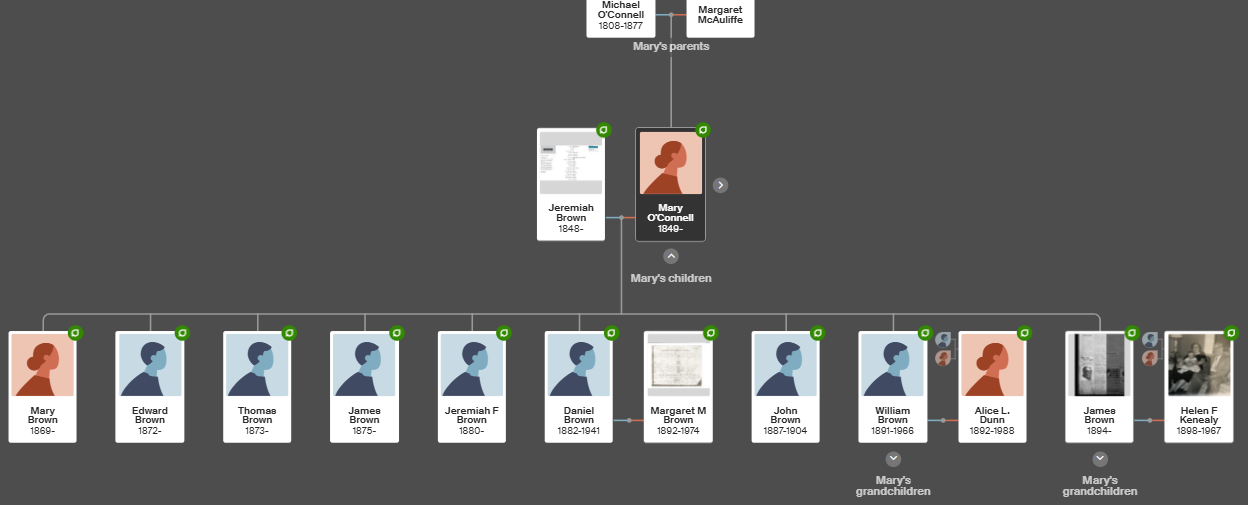
Children of Jeremiah Brown and Mary O’Connell
Mary Brown, born May 1969
Edward Brown born Feb 1872 – 1915
Thomas Brown born Aug 1873
James Brown born 1875
Jeremiah Brown born Jan 1880 – 1947
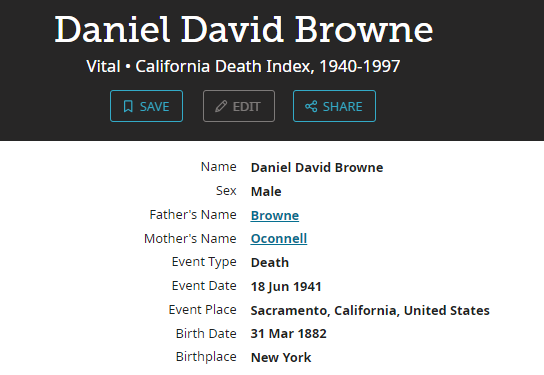
Daniel Brown born March 1882 – 1941
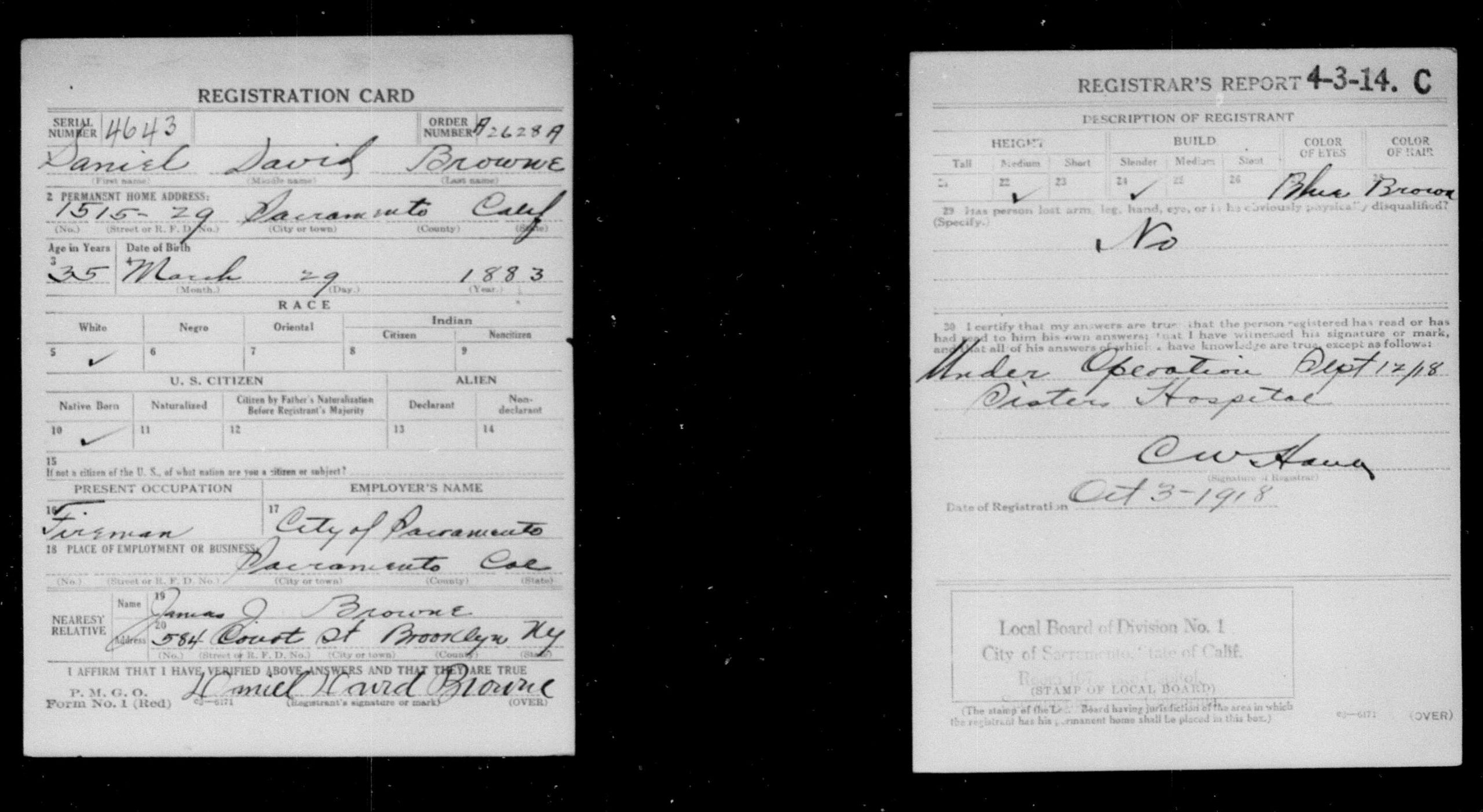
Draft registration 1918 for Daniel David Brown
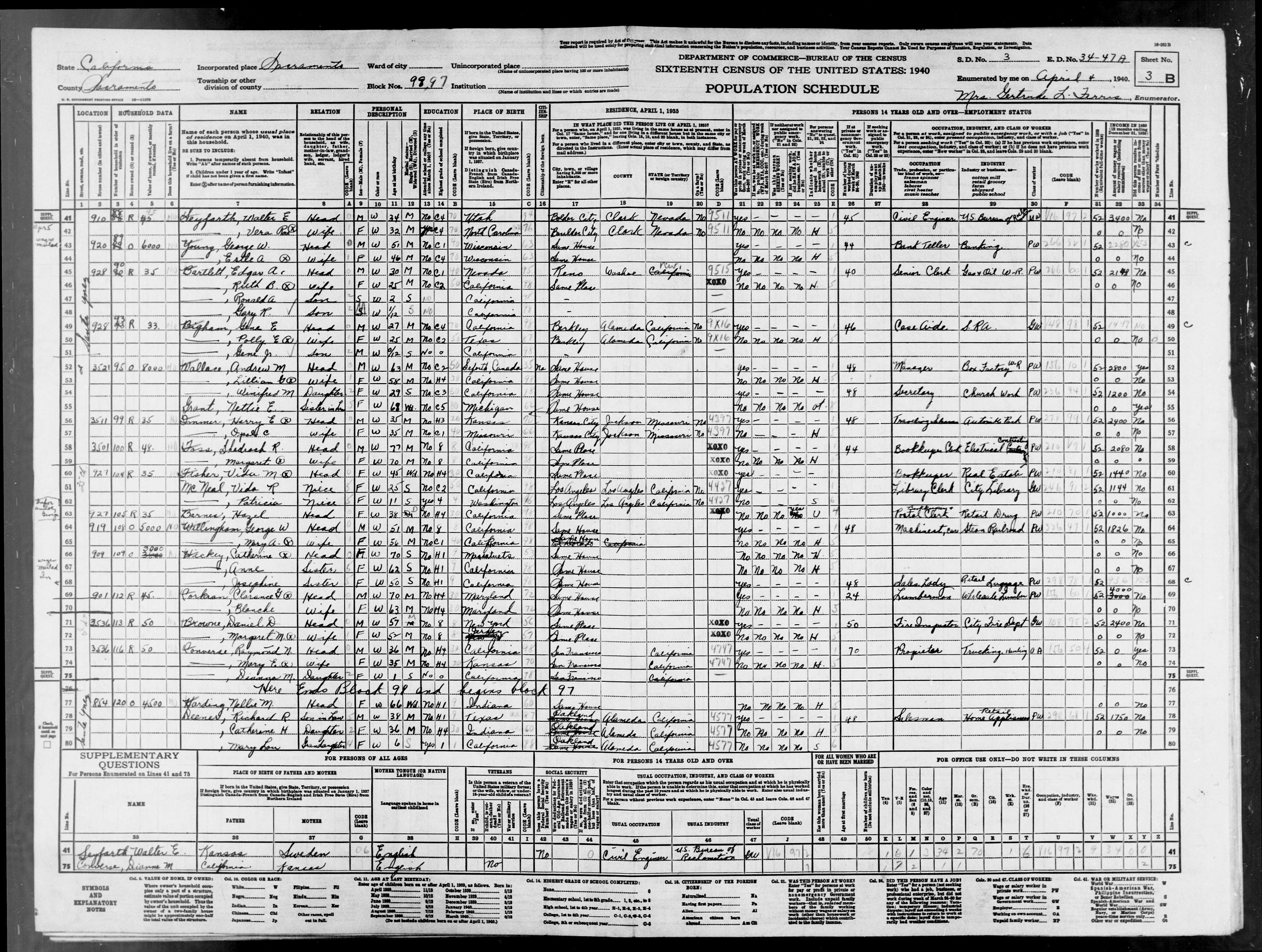
Daniel’s draft registration says his address is 584 Court St., Brooklyn, NY, but a newspaper report after his death in 1941 said he had moved to Sacramento 35 years previously, which would have been 1906. The report also says he joined the Sacramento Fire Department 23 years previously (1918) and that he was Assistant Chief there at the time of his death.
census 1940 Daniel and Margaret Brown
John Brown born Nov 1887 – 1904
William Brown born May 1890 – 1966
James Brown born October 1894 – 1927
Some more postcards from the Brown family:
To Miss Mary F. O’Connell (Mary Frances O’Connell 1889 – 1984) It says “Dear Mary, Received your kind and most welcome letter today and was glad to hear all is well. Myself, sisters and friend here are fine T.G. The weather is getting cold here at present with a fresh supply of snow today. Kind regards to father, mother and James and accept the same for yourself. Will write later. Good-bye from your cousin, M O’C. this was posted in Philadelphia in 1910
To Mr. James O’Connell It says “Dearest J. It’s time for me to answer your pc but I had a very sore finger and I couldn’t possibly write. I may go to Drum next Sunday and if it is fine I hope to see you. I hope all are well in Milford. Nothing strange here. M & E. M this one seems to be posted in Newmarket
To Miss Mary O’Connell (Mary Frances O’Connell 1889 – 1984) , Milford from Mrs M. Creagh, 2108 (Darce?) St., Fort Wayne, Ind. It only says “I will send memory of the past (she is referring to the picture on the postcard) and love to you and mama.
To Patrick Creagh, Kilmore, Milford from Mary Brown . Her address is 346 Hamilton Avenue so it may have been written around 1909. She wrote: “Dear Pat, Glad to hear you are hale and strong. Hope you had a merry Xmas. I wish you a happy new year cousin Mary Micky all are well here Mary Brown one of my lads are going over next summer to see you all.”
Daniel Brown (son of Mary O’Connell Brown) went to Ireland in 1910 – the following is the ship manifest for United States citizens who sailed on the ship “Arabic” which left Queenstown (Cork) on 11 Sept 1910

:quality(70)/cloudfront-eu-central-1.images.arcpublishing.com/irishtimes/FB6ZIQH3JNJCM54SL5L7WIDPWQ.jpg)